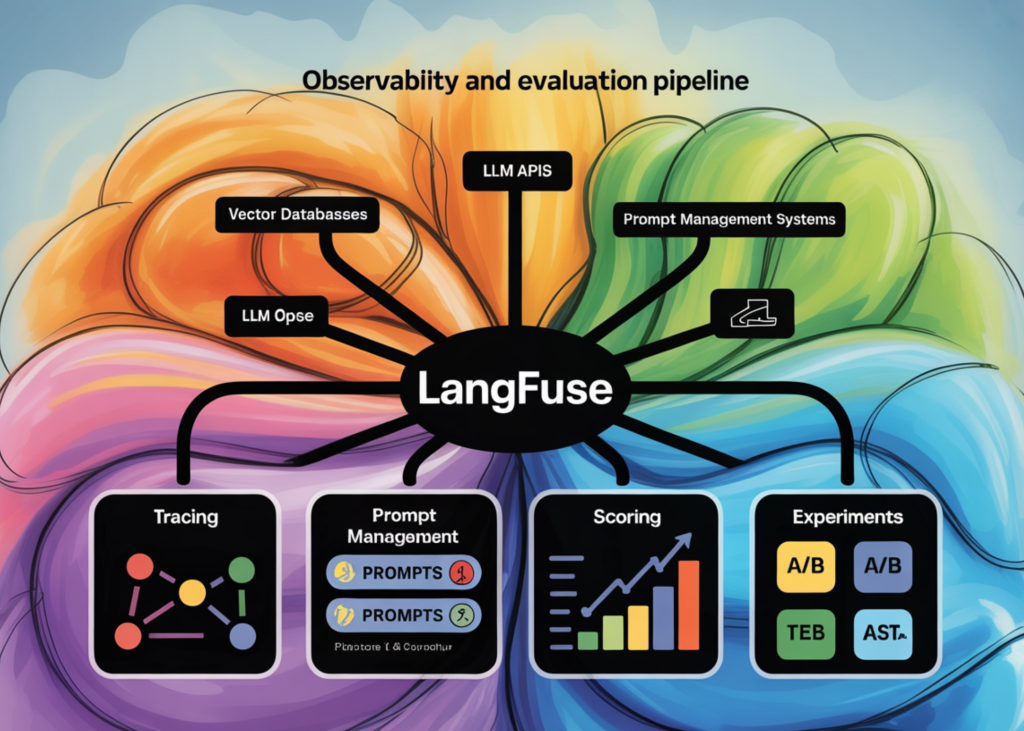
Build a Complete Langfuse Observability and Evaluation Pipeline for Tracing, Prompt Management, Scoring, and Experiments
Quick Answer
This tutorial outlines the implementation of the Langfuse pipeline for tracing, prompt management, and scoring, utilizing either a real OpenAI key or a deterministic mock LLM.
Quick Take
It enables users to explore Langfuse's features without needing paid model access, providing a comprehensive workflow for evaluation and experimentation.
Key Points
- Langfuse is an open-source engineering platform for observability and evaluation.
- The pipeline supports both real OpenAI keys and deterministic mock LLMs.
- Users can explore major Langfuse features without paid model access.
- The tutorial provides a complete workflow for tracing and prompt management.
- Focus on scoring datasets and conducting experiments effectively.
Article Excerpt
From source RSS / original summaryIn this tutorial, we implement the Langfuse (an open-source engineering platform) pipeline for tracing, prompt management, scoring, datasets, and experiments. We build a complete workflow that works with either a real OpenAI key or a deterministic mock LLM, so we can understand every major Langfuse feature without depending on paid model access.
We start […] The post Build a Complete Langfuse Observability and Evaluation Pipeline for Tracing, Prompt Management, Scoring, and Experiments appeared first on MarkTechPost.
Want this in your inbox every morning?
Daily brief at your local 8am — bilingual EN/中文, free.
More from MarkTechPost
See more →Meet Flash-KMeans: An IO-Aware, Exact K-Means That Runs Over 200× Faster Than FAISS on GPUs
Flash-KMeans is an open-source, IO-aware k-means implementation that operates over 200× faster than FAISS on NVIDIA H200 GPUs. It achieves 17.9× end-to-end and 33× speedup over cuML by optimizing distance calculations and updating mechanisms without approximating results. This advancement significantly enhances performance for data scientists and machine learning practitioners.