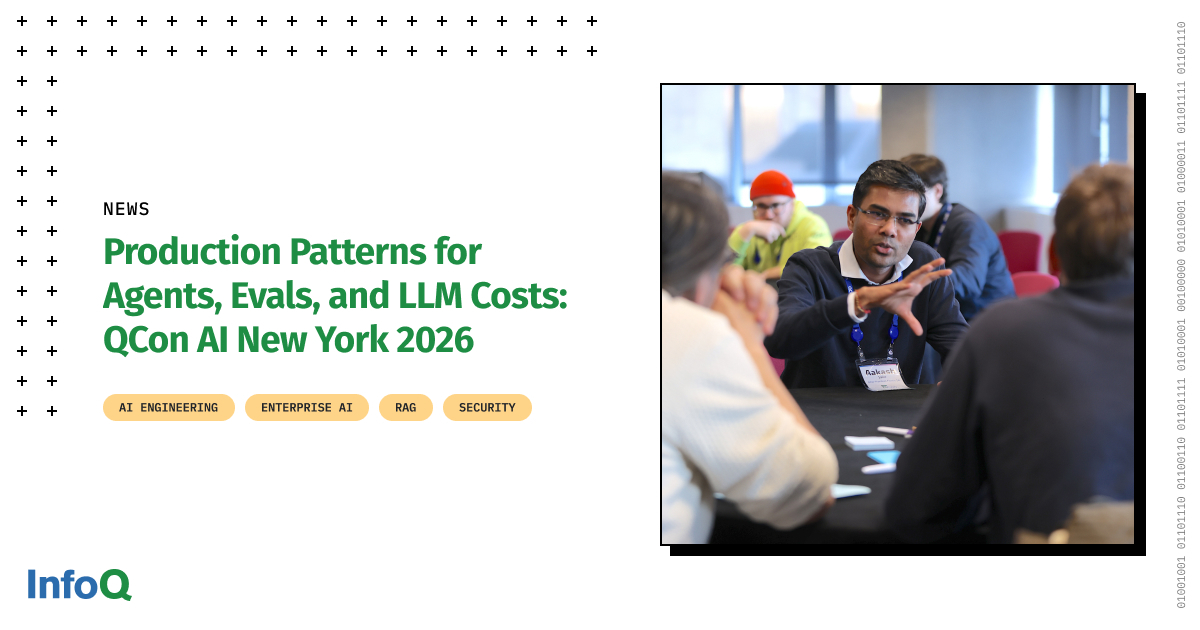
Production Patterns for Agents, Evals, and LLM Costs: QCon AI New York 2026
Quick Answer
QCon AI New York 2026 will address production challenges in AI, focusing on agent permissions, eval reliability, and cost management.
Quick Take
Senior engineers from LinkedIn and DoorDash will share insights on identity controls and efficient code review processes, aiming to help teams implement effective guardrails and avoid costly mistakes.
Key Points
- Nancy Wang presents identity solutions for agents, avoiding long-lived service accounts.
- Ronak Nathani discusses guardrails for production changes in LinkedIn's Kubernetes environment.
- Fabio Flores emphasizes the importance of consistent evals for production readiness.
- Min Chen proposes filtering low-confidence AI code suggestions to streamline reviews.
- Nathen Harvey explores assessing AI maturity beyond adoption metrics.
DeepSignal Analysis
What happened
QCon AI New York 2026 will focus on production challenges in AI, featuring sessions from senior engineers at LinkedIn and DoorDash. Topics include agent permissions, eval reliability, and cost management, with practical insights from those who have implemented solutions in production environments.
Key evidence
- Nancy Wang, founder of AWS Data Protection, will discuss identity and authorization for agents in production, highlighting the risks of long-lived service accounts.
- Fabio Flores from DoorDash will present on the importance of consistent evals across simulated and production sessions to ensure reliable performance.
- Min Chen at LinkedIn will address the challenge of AI-generated code outpacing human review, proposing methods to filter low-confidence findings before they reach developers.
Why it matters
The conference aims to equip senior engineers and technical leaders with practical strategies to navigate the complexities of AI in production. By sharing real-world experiences, attendees can learn from the successes and failures of others, potentially avoiding costly mistakes in their own implementations. This focus on practical solutions is crucial as organizations increasingly rely on AI technologies.
📖 Reader Mode
~4 min readOnce AI is in production, code arrives faster than it can be reviewed, token costs rise, evals have to be good enough to act on, and agents need permissions and guardrails. QCon AI New York 2026 has confirmed sessions from senior engineers who have worked through these problems in systems they run. The conference takes place December 15-16 at The Westin Jersey City Newport, about five minutes by PATH train from the World Trade Center. It is for senior engineers and technical leaders making decisions on production AI.
What the sessions offer is hindsight. The senior engineers presenting have already made these decisions and run the results in production. They describe the system and the numbers behind it, letting another team compare an approach against its own constraints before committing.
Identity and authorization for agents in production
The QCon AI opening keynote describes two bad options for giving an agent production access. Teams hand it a long-lived service account and hope, or scope access too narrowly until it cannot finish its task. Nancy Wang, who founded and scaled AWS Data Protection, provides alternative solutions in When Software Becomes a User: Identity and Authorization for Agents in Production.
See what those controls look like on a live platform. Implement guardrails that sit on the server, including rate limits and peer approval for production changes, from Ronak Nathani, who led the move to Kubernetes at LinkedIn. He presents Inside LinkedIn's Kubernetes Ops Agent: Skills, Tools, and Guardrails, detailing an operations agent working across 500,000+ nodes and 5M+ pods. Together, the two talks give a team an authorization model and a working set of guardrails to compare with its own.
Whether a change is safe to ship, and what it costs to run
An eval is useful when engineers trust the score enough to ship or hold on it. Fabio Flores, who leads foundation development for Agentic Ordering at DoorDash, will argue that engineers should apply one judge to both simulated and production sessions so improvements measured before launch carry into production. He presents From Signal To Impact: The Eval Loop Behind DoorDash's Agentic Ordering System.
Agent workloads that worked as prototypes can become too expensive in production as context grows. Tejas Chopra, who previously worked on distributed caching infrastructure at Netflix, will explore how to implement prompt compression and ordering that increases provider cache hits. In Make Each Token Count: Compression, Caching, and Retrieval for Production LLM Context, he covers tiered storage for conversation history and the failure modes his team hit.
When AI writes code faster than teams can review it
Human review becomes the bottleneck as AI tools generate more code. Min Chen, who leads the move to AI-native software engineering at LinkedIn, suggests engineers should filter low-confidence findings before developers see them. She presents High-Signal AI Code Review That Adapts to Your Codebase at Scale. The system reviews tens of thousands of pull requests a week across roughly 10,000 repositories, and she explains how the team measures whether suggestions make it into merged code.
Faster output does not help every organization equally. Nathen Harvey, who leads DORA at Google Cloud, will explore how to assess AI maturity beyond adoption metrics and identify which existing problems AI is likely to make worse. He argues in Building in the AI-First World: Scale Brilliance, Not Bottlenecks that AI amplifies what an organization already does well and what it does badly.
What teams take back
The QCon AI Program Committee invites senior practitioners who are doing something other teams can learn from. The talks are vendor-neutral with no hidden product pitches, so each one is an account of what a team built and why. With one speaker for every eleven attendees, there is also time for a follow-up question for the person who built the system. The aim is for teams to return with patterns ready to adopt and costly mistakes they can avoid.
All confirmed talks are on the QCon AI New York 2026 sessions page.
About the Author
Artenisa Chatziou
Show moreShow less
— Originally published at infoq.com
Want this in your inbox every morning?
Daily brief at your local 8am — bilingual EN/中文, free.
More from InfoQ AI, ML & Data Engineering
See more →Google Cloud Workbench Notebooks Extension Connects VS Code to Google Cloud's Jupyter Notebooks
The Google Cloud Workbench Notebooks extension for VS Code allows developers to seamlessly connect their local IDE to managed Jupyter notebook environments on Google Cloud, enhancing ML workflow efficiency. This integration eliminates context switching, enabling smooth transitions from local experimentation to high-performance cloud computing.