
A New Study from Harvard and Perplexity Finds AI Agents Perform 26 Minutes of Autonomous Work per Session vs 33 Seconds for Search
Quick Answer
A study from Harvard and Perplexity reveals that AI agents can autonomously work for 26 minutes per session, significantly outperforming traditional search assistants, which only manage 33 seconds.
Quick Take
This research highlights substantial improvements in autonomy, time efficiency, and cost-effectiveness, indicating a broader scope of tasks that AI agents can undertake.
Key Points
- AI agents achieve 26 minutes of autonomous work per session.
- Traditional search assistants only manage 33 seconds of work.
- The study indicates significant gains in autonomy and efficiency.
- Broader scope of tasks attempted by AI agents is noted.
- Research conducted by Harvard and Perplexity highlights these findings.
📖 Reader Mode
~7 min readA new working research from Perplexity and Harvard offers field evidence on what AI agents do to knowledge work. It draws on production data from two Perplexity products: Search and Computer.
The setup is a natural comparison. Search is a conversational answer engine. Computer is an agent that plans and executes tasks end to end. The same users touch both products, so the team can hold the task roughly constant.
What the Study Actually Measures
The research study covers a 90-day window, February 27 through May 27, 2026. Computer launched two days before that window opened.
The core method matches near-identical query pairs across the two products. The research team found 10,000 session pairs with cosine similarity above 0.99. Each pair is effectively the same task attempted both ways.
Computer pairs are gated to sessions that invoke an execution tool. These ‘do’ tools include code execution, browser actions, file writes, and connector calls. That gate ensures every Computer session does real autonomous work.
Adoption rose over the window. Cumulative Computer queries reached 84× their first-week total. A matched analysis found Computer adoption also raised users’ daily Search queries by 1.05. The positive effect points to complementarity, not substitution.

The Cost-Structure Framework
The research grounds its data in a simple task-based model. Each task has a step count, and longer tasks carry weakly higher value.
Agents change the cost structure. They charge a higher fixed cost per task, for delegation and review. But they charge a lower marginal cost per step, since the system executes.
This produces a breakeven step count. Below it, the conversational mode is cheaper. Above it, the agent mode wins. Short lookups stay manual; long workflows move to the agent.
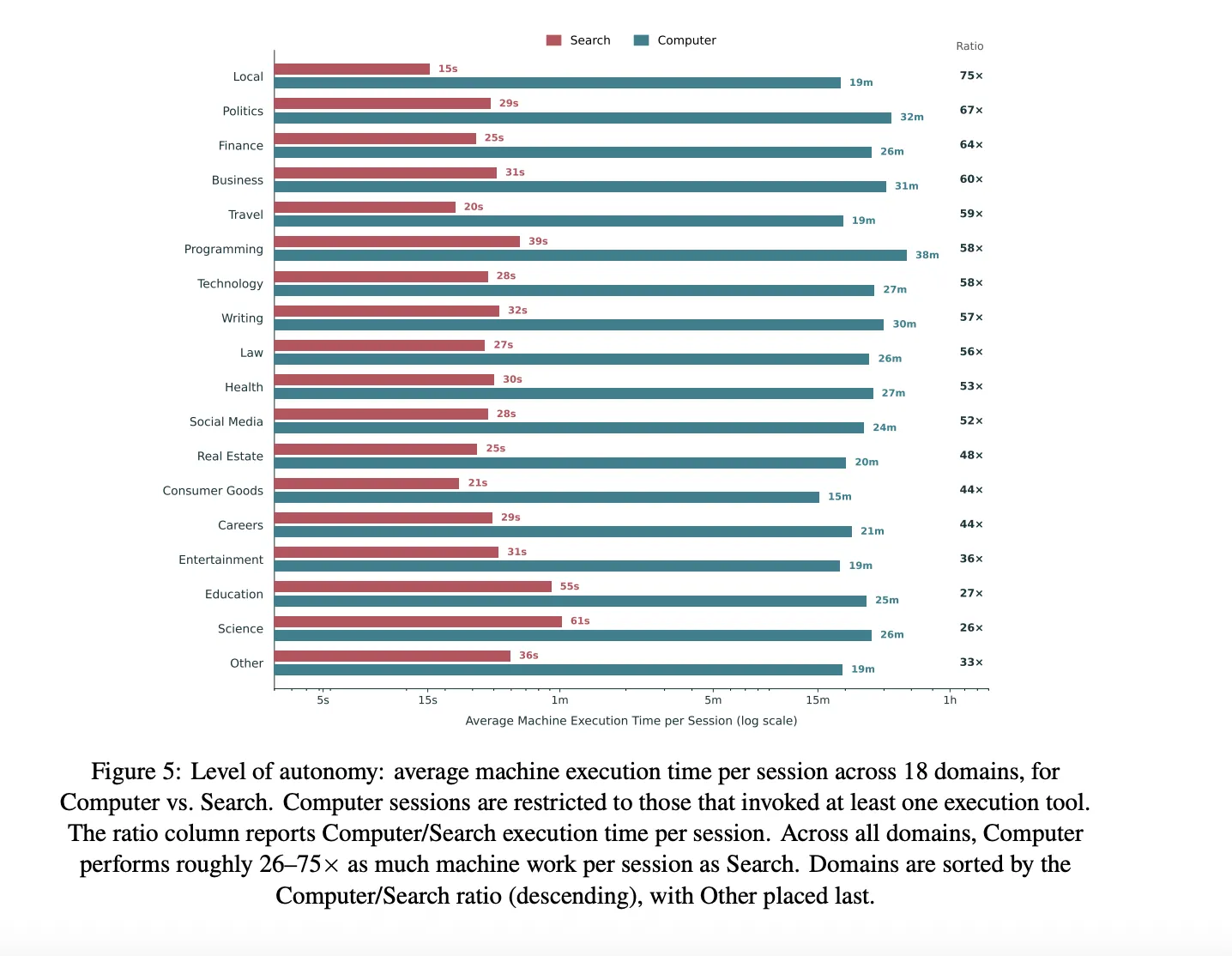
The first autonomy measure is execution time. Computer runs 26 minutes of machine work per session. Search runs 33 seconds. That is a 48× gap.
Medians show the same pattern: 9 minutes versus 14 seconds. The gap varies by domain. Local tasks show 75×; Science shows 26×, since plain answers often suffice.
Higher autonomy did not lower quality here. The research team scored next-turn dissatisfaction from what users do next. Computer’s meaningful dissatisfaction rate was 1.3%, against 2.9% for Search (55% reduction).
Follow-up turns also shift toward review and extension on Computer, though the changes are small. Connector usage rose more clearly. Computer invoked at least one connector in 7.9% of sessions, versus 1.8% for Search. Computer chains external tools that Search users would otherwise run by hand.
Efficiency: Where the Savings Come From
The efficiency section estimates a Search + Human counterfactual. A human with Search alone takes 269 minutes per matched task. Computer + Human takes 36 minutes.
That is 87% less time and 94% less cost overall. Cost savings exceed time savings because domain wages amplify the effect. Computer’s model cost runs $4–10 per task; Search runs about $0.05.
The marginal numbers support the framework. Computer + Human costs $0.16 per step, versus $2.05 for Search + Human. Matched Computer sessions also ran longer prompts, 652 versus 448 characters at the median. That supports the higher fixed-cost assumption for agents.
Breakeven analysis says a professional must finish all manual steps in under 20 minutes to match Computer. The research team cross-checked with an independent LLM estimate and user interviews. The LLM method found 84% time and 93% cost savings. Interviewees reported speedups from 5× to 300×.
Horizontal and Vertical Expansion
Scope is where this research extends past prior work. Autonomy does not just speed up tasks. It changes which tasks users attempt.
Horizontally, Computer queries cross occupational lines more often. Cross-occupation share averaged 59% on Computer, versus 50% on Search. Management and Entrepreneurship showed the largest gap, at 19 points.
Vertically, Computer queries are more demanding. On Bloom’s Revised Taxonomy, 76% required higher-order cognition, versus 55% for Search. Create-level work was 50% of Computer queries, against 26%.
Computer tasks also span more knowledge domains. Each query touched 2.40 O*NET Knowledge domains on average, versus 1.74. It was nearly three times as likely to need three or more domains.
Composability climbs as the O*NET hierarchy gets finer. At the Task Statement level, Computer engaged 60% more activities. About 23% of Computer queries hit a Task Statement that the same users never sent to Search.
Comparison Table: Search vs Computer
| Dimension | Perplexity Search | Perplexity Computer |
|---|---|---|
| Mode in the framework | Conversational answer engine | Agent orchestrator |
| Machine time per session | 33 seconds (median 14s) | 26 minutes (median 9m) |
| Queries per session | 2.8 | 5.3 |
| Meaningful (mid+high) dissatisfaction | 2.9% | 1.3% |
| Sessions with a connector call | 1.8% | 7.9% |
| Counterfactual task time | 269 min (Search + Human) | 36 min (Computer + Human) |
| Cost per step | $2.05 | $0.16 |
| Model cost per task | ~$0.05 | $4–10 |
| Cross-occupation query share | 50% | 59% |
| Higher-order Bloom cognition | 55% | 76% |
| O*NET Knowledge domains per query | 1.74 | 2.40 |
Key Takeaways
- Computer runs 26 minutes of autonomous work per session versus 33 seconds for Search, a 48× gap.
- On matched tasks, Computer + Human cuts estimated time 87% and cost 94% versus Search + Human.
- Computer’s meaningful dissatisfaction rate is 1.3% versus 2.9% for Search, a 55% reduction.
- Computer queries cross occupations more (59% vs 50%) and demand more higher-order cognition (76% vs 55%).
- About 23% of Computer queries hit a Task Statement the same users never sent to Search.
Marktechpost’s Visual Explainer
Research Guide
Harvard × Perplexity
01 / 10
How AI Agents Reshape Knowledge Work
Autonomy, Efficiency, and Scope — field evidence from production data.
- A new study compares an autonomous agent with a conversational search assistant.
- It uses real usage data from Perplexity Search and Perplexity Computer.
Jeremy Yang (Harvard) · Kate Zyskowski, Noah Yonack, Jerry Ma (Perplexity) · arXiv:2606.07489v1
02 / 10
What the Study Measures
A matched-pair design holds the task roughly constant across products.
- 90-day window: February 27 to May 27, 2026.
- 10,000 matched session pairs with cosine similarity above 0.99.
- Computer sessions are gated to “do” tools: code execution, browser actions, file writes, connector calls.
- The same dual-product users appear on both sides.
03 / 10
The Cost-Structure Framework
A simple task-based model explains when delegation pays off.
- The agent mode charges a higher fixed cost per task, for delegation and review.
- It charges a lower marginal cost per step, since it executes.
- A breakeven step count sorts work: short below it, agent above it.
- Task selection is modeled as a 0-1 knapsack problem.
04 / 10
Autonomy: Machine Work per Session
Higher autonomy did not come at a quality cost here.
26 min vs 33 s
Autonomous work per session (48× gap)
9 min vs 14 s
Median session time (40× gap)
1.3% vs 2.9%
Meaningful dissatisfaction (55% lower)
7.9% vs 1.8%
Sessions invoking a connector call
05 / 10
Efficiency: Time and Cost
Estimated against a Search + Human counterfactual on matched tasks.
269 → 36 min
Average task completion time
87% / 94%
Time saved / cost saved overall
$0.16 vs $2.05
Cost per step (Computer vs Search + Human)
< 20 min
Manual-step breakeven to match Computer
06 / 10
Scope: Broader and Harder Work
Autonomy changes which tasks users attempt, not just their speed.
- Horizontal: cross-occupation share 59% vs 50% (Management & Entrepreneurship +19 pp).
- Vertical: higher-order Bloom cognition 76% vs 55%.
- Create-level work: 50% of Computer queries vs 26% for Search.
- Knowledge breadth: 2.40 vs 1.74 O*NET domains per query (+38%).
07 / 10
What Computer Unlocks
Distinctiveness lies in fine-grained executional work, not topical range.
- +60% more O*NET Task Statements engaged per query than Search.
- 23% of Computer queries hit a Task Statement the same users never sent to Search.
- Gains concentrate in software and web development, documentation, and data visualization.
08 / 10
Search vs Computer
Side-by-side across the study’s main measures.
| Dimension | Search | Computer |
|---|---|---|
| Machine time per session | 33 s (med 14 s) | 26 min (med 9 m) |
| Queries per session | 2.8 | 5.3 |
| Meaningful dissatisfaction | 2.9% | 1.3% |
| Cost per step | $2.05 | $0.16 |
| Cross-occupation share | 50% | 59% |
| Higher-order cognition | 55% | 76% |
| O*NET domains per query | 1.74 | 2.40 |
09 / 10
Use Cases for Engineers
How the findings map to day-to-day technical work.
- Data scientists: single tasks span Design, Mathematics, and Economics and Accounting.
- Software engineers: the agent writes files, runs code, and deploys; you supervise.
- AI engineers: route short lookups to a conversational path, long workflows to an agent.
10 / 10
The Takeaway
From speed to scope.
- Time and cost savings are large but expected.
- The sharper finding is broader, more complex work attempted.
- The practical lesson is task-tool fit: match the tool to the step count.
Source: How AI Agents Reshape Knowledge Work: Autonomy, Efficiency, and Scope (arXiv:2606.07489v1).
Marktechpost Practitioner-first AI/ML research coverage, decoded for engineers.
Need to partner with us for promoting your GitHub Repo OR Hugging Face Page OR Product Release OR Webinar etc.? Connect with us
— Originally published at marktechpost.com
Want this in your inbox every morning?
Daily brief at your local 8am — bilingual EN/中文, free.
More from MarkTechPost
See more →Meet Flash-KMeans: An IO-Aware, Exact K-Means That Runs Over 200× Faster Than FAISS on GPUs
Flash-KMeans is an open-source, IO-aware k-means implementation that operates over 200× faster than FAISS on NVIDIA H200 GPUs. It achieves 17.9× end-to-end and 33× speedup over cuML by optimizing distance calculations and updating mechanisms without approximating results. This advancement significantly enhances performance for data scientists and machine learning practitioners.