Accelerating scientific discovery with ChatGPT for Academic Researchers
Quick Answer
OpenAI is launching ChatGPT for Academic Researchers, providing 100,000 researchers free access to frontier models like GPT-5.6.
Quick Take
This initiative aims to enhance productivity in scientific research, with tools for grant writing, hypothesis testing, and advanced problem-solving, backed by a $250 million commitment through 2027.
Key Points
- Initial rollout includes 10,000 researchers this summer, expanding to 100,000 by 2027.
- Participants can invite up to four collaborators and access advanced models with enhanced features.
- GPT-5.6 Sol Pro scores 83% on FrontierMath Tier 4, outperforming GPT-5.5's 72.5%.
- AI usage in research has surged, with 1.3 million weekly users generating 8.4 million messages.
- The program supports diverse research areas, including genomics, literature reviews, and grant writing.
DeepSignal Analysis
What happened
OpenAI is launching a program called ChatGPT for Academic Researchers, providing 100,000 researchers at selected institutions free access to advanced AI models like GPT-5.6. The initiative aims to enhance productivity in scientific research, offering tools for various tasks including grant writing and hypothesis testing, supported by a $250 million commitment through 2027.
Key evidence
- The program will initially provide access to 10,000 researchers this summer, expanding to 100,000 by 2027, starting with institutions like the Institute for Advanced Study and École normale supérieure.
- Participants will receive access to frontier models, including GPT-5.6, which is designed to assist with complex scientific and mathematical problems, achieving an 83% score on the FrontierMath Tier 4 benchmark.
- The program includes training and support tailored to different experience levels, aiming to help researchers integrate AI tools into their workflows effectively.
Why it matters
This initiative reflects a significant investment in democratizing access to advanced AI tools for researchers, potentially accelerating scientific discovery across various fields. By providing resources to a broader range of researchers, OpenAI aims to foster innovation and collaboration, which could lead to breakthroughs in scientific research that might not occur in more resource-constrained environments.
📖 Reader Mode
~6 min readWe believe the benefits of frontier AI should not be concentrated in a few companies and well-resourced labs. Scientific progress depends on researchers asking the right questions, testing new ideas, and building on what others have discovered. Our role is to put powerful tools in their hands—and work alongside them to design models that accelerate their research while keeping them in control.
We’re introducing ChatGPT for Academic Researchers, a program that will give 100,000 researchers at selected academic institutions free access to our frontier models. The program will help researchers across the sciences, mathematics, and engineering take on advanced problems, accelerate discovery, and improve productivity, from preparing grant applications to testing hypotheses
We’re starting with 10,000 researchers this summer, with access already available at institutions such as the Institute for Advanced Study (IAS) and École normale supérieure (ENS). We plan to expand to 100,000 researchers through 2027. Participants will have access to our frontier models, including GPT‑5.6 Sol Pro at launch, and can invite up to four collaborators from their institution. Workspaces include business-grade privacy and security protections, and data is not used to train our models by default. Researchers can use tools and skills to support work ranging from genomic analysis and protein modeling to literature reviews, grant writing, and publishing.
The program also includes training, hands-on support, and opportunities to learn from other researchers and share feedback with us.
For institutions with ChatGPT Edu, free access granted through this program will be coordinated through the institution's workspace. Learn more about ChatGPT Edu and how OpenAI supports higher education.
ChatGPT for Academic Researchers is part of a commitment of more than $250 million through 2027 to support external scientific research and discovery. That includes NextGenAI, our $50 million initiative supporting research institutions, and our work with the Department of Energy’s Genesis Mission to bring frontier AI to researchers at national laboratories and universities. Together, these efforts reflect our belief that scientific progress accelerates when more researchers have the tools to pursue their own ideas.
AI is accelerating research
AI is becoming a more capable research tool faster than many expected. Each week, roughly 1.3 million people use ChatGPT for advanced science and mathematics, generating about 8.4 million messages.
The shift is especially visible in mathematics. In the past six months, AI has moved from occasional use on isolated problems to a more regular part of mathematical research. A growing number of papers now acknowledge ChatGPT’s contribution, reflecting how quickly researchers are adopting these tools in their work.
* Incomplete month; the full-text index currently extends through July 21.
Researchers use ChatGPT and Codex across nearly every stage of scientific work. ChatGPT helps researchers interrogate ideas, acquire knowledge, generate hypotheses, and communicate their findings. Codex supports research execution and formal analysis, including writing code and analyzing results.
Share of scientific research requests by scientific workflow category and product, June 21–July 20, 2026
These patterns are showing up in research. Physicist Rogerio Jorge and his team are using AI to develop open-source fusion research software used by industry and national laboratories to design fusion energy devices. In theoretical computer science, researchers Barna Saha, Yinzhan Xu, and Christopher Ye used GPT‑5.5 Pro to develop a proof establishing new limits on how efficiently computers can solve high-dimensional geometry problems, then validated and refined the results themselves.
Researchers using these tools most intensively are also taking on more ambitious work. Those in the top 20% of AI usage within their field are almost twice as likely as their peers to ask AI to take on tasks estimated to require four hours or more: nearly 7% of their requests, compared with 3.5% among other researchers in the same field.
Share of scientific requests by estimated active human work time and scientist AI intensity, June 21–July 20, 2026
Our strategy is not to decide which scientific problems deserve attention or try to solve them all ourselves. It is to put capable tools in the hands of the research community and let researchers pursue the questions they know best.
What participants will get
Participants will receive free access to our frontier models across ChatGPT, ChatGPT Work, and Codex, including the GPT‑5.6 family of models at launch. They will also have expanded deep research, higher usage limits, and larger context windows. Together, these capabilities support scientific reasoning, agentic execution, and research workflows across disciplines.
GPT‑5.6 Terra balances capability and efficiency for everyday research, GPT‑5.6 Luna provides faster responses for lighter-weight tasks, and GPT‑5.6 Sol tackles the most difficult scientific and mathematical problems. On FrontierMath Tier 4, which measures research-level mathematical reasoning, GPT‑5.6 Sol scores 83%, compared with 72.5% for GPT‑5.5. On GeneBench Pro, which evaluates complex biological data analysis and scientific reasoning, GPT‑5.6 Sol Pro solves 31.5% of tasks.
Researchers can use more than 75 life science skills(opens in a new window) spanning genetics, genomics, sequencing, single-cell analysis, protein modeling, and drug discovery. Connectors support research across disciplines, providing access to scientific literature, public genomic and clinical databases, satellite imagery, computational notebooks, data platforms, and reference managers.
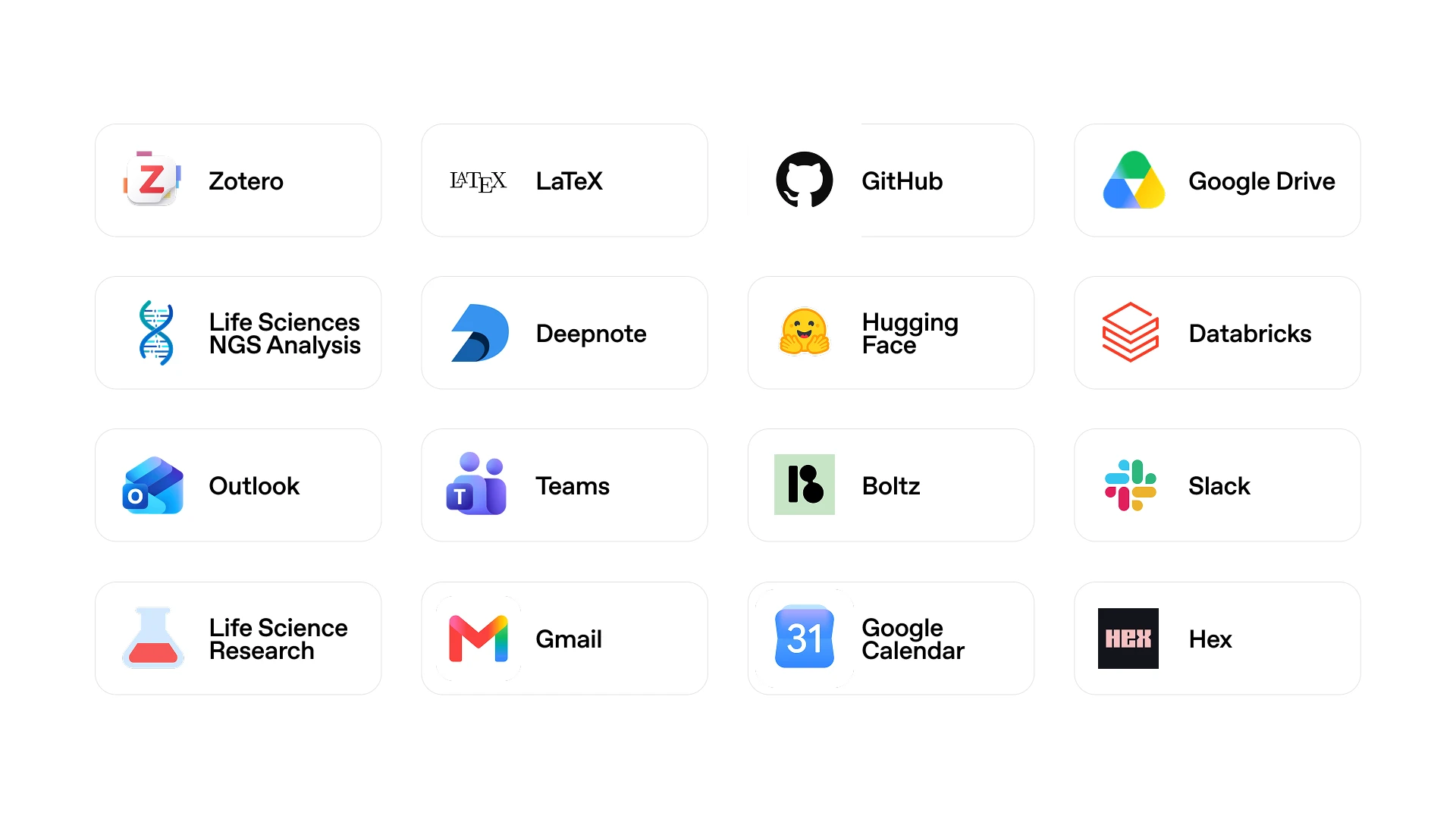
Representative examples of skills, connectors, and tools available across ChatGPT and Codex.
Codex can help write and debug code, analyze datasets, and build reproducible workflows. ChatGPT Work can support longer projects such as finding funding opportunities, preparing grant applications, reviewing literature, drafting manuscripts, and creating materials to communicate results.
Training and research support
Researchers will have different starting points with AI. Some may be using these tools for the first time; others may be developing advanced applications in their fields.
The program will offer training tailored to different levels of experience, from getting started and improving workflows to advanced research applications. Participants will have access to specialists familiar with research workflows, including help integrating these tools into their work.
As we see what researchers discover, we plan to create more opportunities for researchers to share practical approaches, learn from one another, and highlight uses across disciplines. Their feedback will help us understand where our models are useful, where they fall short, and how to make them more valuable to the research community.
How to apply
The initial program is open to qualifying researchers at selected academic institutions. Eligible institutions(opens in a new window) must be recognized, degree-granting colleges or universities with a high level of research activity.
Applicants will need to verify their institutional affiliation and provide information about their active research and intended scientific use. Approved researchers may invite up to four collaborators from their institution. Each collaborator must also verify their affiliation and counts toward the program’s total number of accounts.
— Originally published at openai.com
Want this in your inbox every morning?
Daily brief at your local 8am — bilingual EN/中文, free.
More from OpenAI Blog
See more →Scientific computing in the age of agentic AI
AI agents are transforming scientific computing by streamlining software development, enabling researchers to focus on discovery. Projects using Codex and Claude Code report accelerated development and improved maintenance, though challenges in validating AI outputs remain. Long-term stewardship of research software is crucial to ensure reliability and reproducibility.