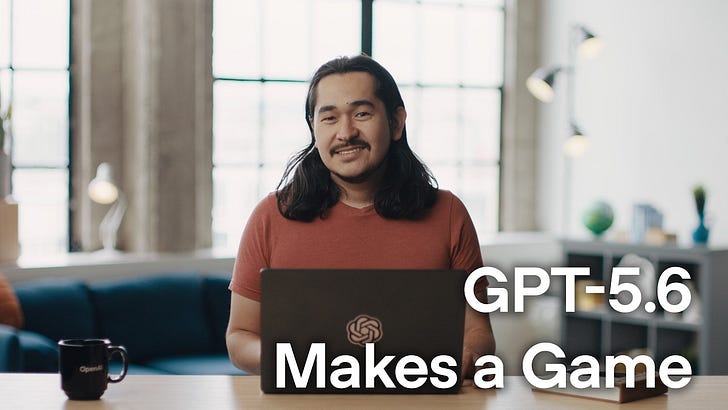
[AINews] OpenAI launches GPT 5.6 Sol/Terra/Luna, Codex becomes ChatGPT superapp
Quick Answer
OpenAI has launched GPT-5.6 with three models: Sol, Terra, and Luna, achieving superior performance at lower costs compared to competitors.
Quick Take
Notably, Sol scores 53.6 on Agents' Last Exam, outperforming Claude Fable 5 by 13.1 points, while Terra and Luna offer even lower-cost options with significant efficiency gains.
Key Points
- GPT-5.6 models Sol, Terra, and Luna offer enhanced performance and cost efficiency.
- Sol achieves a score of 53.6, outperforming Claude Fable 5 by 13.1 points.
- Terra and Luna provide lower-cost alternatives with significant efficiency improvements.
- New desktop app ChatGPT Work integrates Codex and ChatGPT functionalities.
- API pricing tiers set Sol at $5, Terra at $2.5, and Luna at $1 per million tokens.
📖 Reader Mode
~16 min readOn any other day, the launch of a surprisingly good/competitive Muse Spark 1.1 from Meta Superintelligence Labs, including, for the first time, in the Meta Model API (signaling high confidence for broad usage and third party testing which is bearing out in their sister models), would deserve title story status, but they had the misfortune of going up against a mainline frontier model launch:
As previewed a couple weeks ago before government approval, 5.6 comes in three new sizes, Sol, Terra and Luna, corresponding to the sizes of Sun, Earth and Moon, as an alternative to the more literary sizing of Claude variants, and a new ultra effort level, “our highest-capability setting, coordinating multiple agents across parallel workstreams to finish complex tasks faster”:
maxgives GPT‑5.6 even more time thanxhighto reason and explore alternatives, run checks, and revise its approach. ultra goes further by coordinating four agents in parallel by default, trading higher token use for stronger results and faster time-to-result on demanding tasks.
On multiple benchmarks (not just the ones featured here), 5.6 both achieves higher performance at lower cost than Fable or Opus.
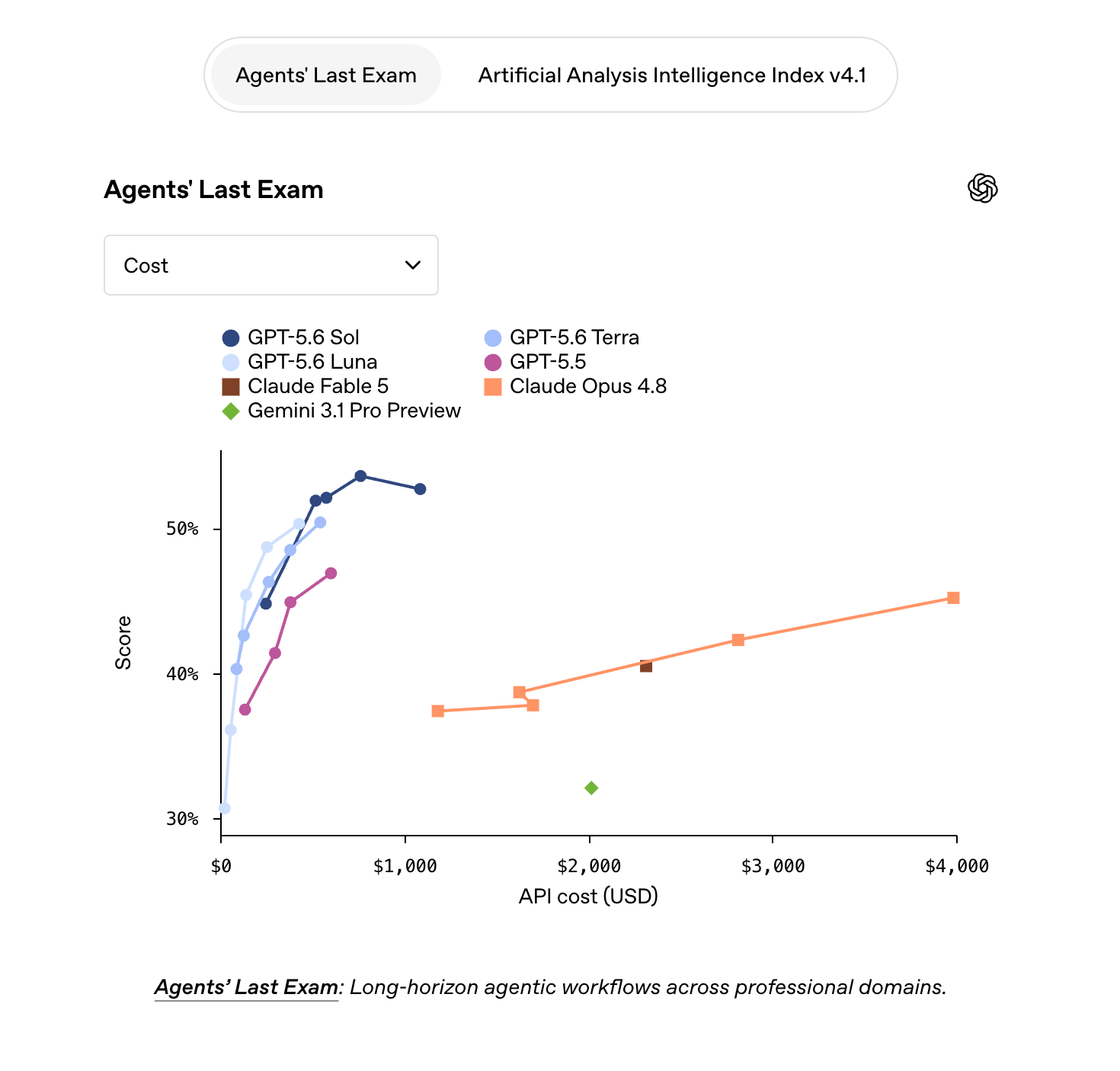
“Terra performs just above Fable 5, while Luna outperforms Opus 4.8; each does so in roughly one-third of the time, with about half as many output tokens, and at approximately one-quarter the estimated cost. It also sets new state-of-the-art results on Terminal‑Bench 2.1 and DeepSWE, which test complex command-line workflows and long-horizon engineering in real codebases.”
There are also harder-to-benchmark improvements in computer use, presentation/document generation, and scientific research that should nevertheless be taken very seriously.
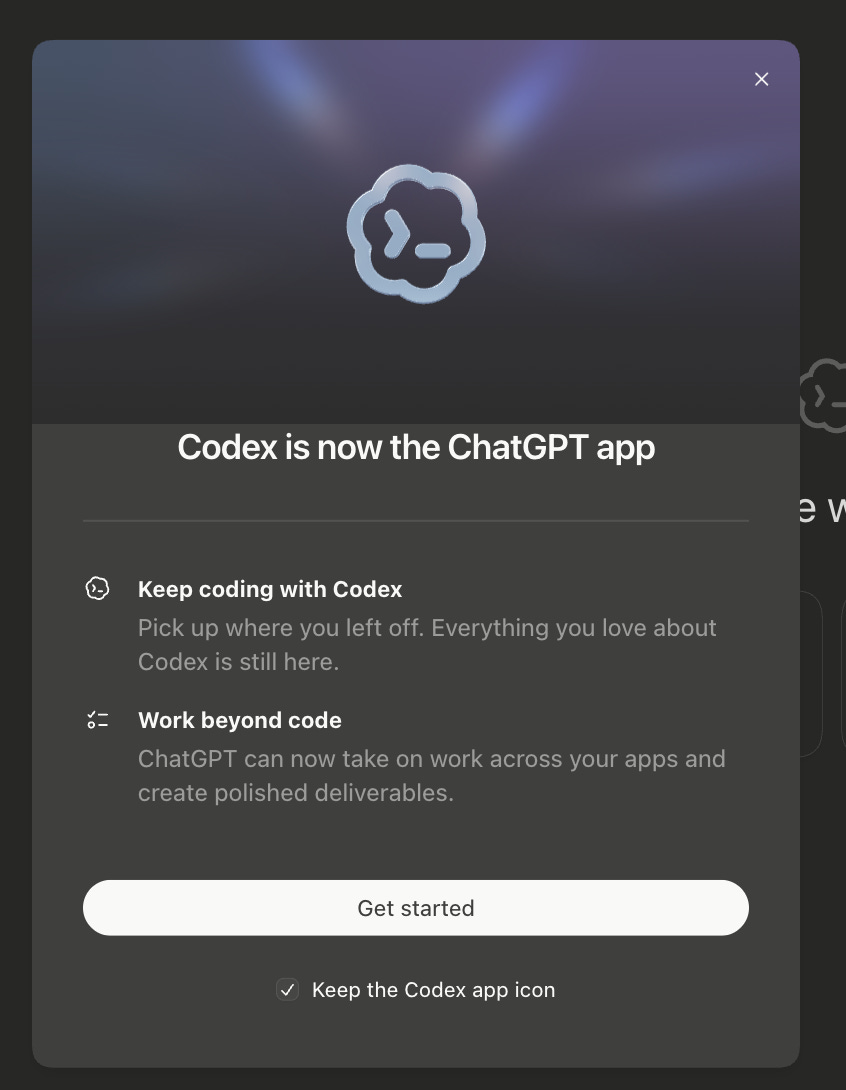
As we predicted in April, the newly launched ChatGPT Work and Codex desktop app update today is probably the penultimate step for OpenAI’s superapp strategy (the last open question is what happens to the agentic browser….)
AI News for 7/08/2026-7/09/2026. We checked 12 subreddits, 544 Twitters and no further Discords. AINews’ website lets you search all past issues. As a reminder, AINews is now a section of Latent Space. You can opt in/out of email frequencies!
OpenAI launched a new three-model GPT‑5.6 family and simultaneously expanded the product stack around it.
OpenAI announced GPT‑5.6 Sol, Terra, and Luna rolling out across ChatGPT, Codex, and the API via @OpenAI and @OpenAIDevs
In ChatGPT, Plus, Pro, Business, and Enterprise users get access to GPT‑5.6 Sol through medium+ effort settings, while Pro and Enterprise can select GPT‑5.6 Pro for highest-quality results on complex tasks, per @OpenAI
API pricing introduced a tiered lineup: Sol $5 / $30 per million input/output tokens, Terra $2.5 / $15, Luna $1 / $6, with cache-write pricing added for the first time and 90% cache-read discount retained, according to @ArtificialAnlys
OpenAI framed the family around a price-performance ladder: Sol = flagship/highest ceiling, Terra = GPT‑5.5-like capability at lower cost, Luna = fastest/cheapest high-volume option, via @OpenAIDevs
The launch bundled major app-layer changes: ChatGPT Work, a new desktop app merging Codex + ChatGPT, Sites beta, programmatic tool calling, and multi-agent beta in the Responses API, via @OpenAI, @OpenAIDevs, and @OpenAIDevs
OpenAI’s official message emphasized strong agentic/coding performance, better artifact quality, and improved economics.
Sam Altman called it “obviously the best model we have ever produced” in the launch post, linking the release blog, via @sama
Altman also highlighted enterprise economics: “5.6 sol is a huge step forward for dollars-per-task,” via @sama
Greg Brockman said the goal is “the best price for any level of target performance” and the highest possible ceiling, via @gdb
OpenAI claimed GPT‑5.6 Sol sets a new high of 53.6 on Agents’ Last Exam, beating Claude Fable 5 adaptive by 13.1 points; at medium reasoning it beats Fable by 11.4 points at roughly one-quarter the estimated cost, while Terra and Luna also outperform Fable at around one-sixteenth the cost, via @OpenAI
OpenAI said GPT‑5.6 improves artifact quality across presentations, documents, and spreadsheets, with outputs exportable into existing enterprise tools, via @OpenAI
OpenAI positioned GPT‑5.6 as state of the art for reasoning through complex tasks and for producing materials matched to templates, reference files, and preferred style inside ChatGPT Work, via @OpenAI
OpenAI also said GPT‑5.6 is its most capable model yet on cyber and bio-related tasks, with some API calls potentially blocked or paused for extra safety review in dual-use areas, via @OpenAIDevs
OpenAI highlighted better Computer Use performance: faster, more token-efficient, support for batching and parallel operations across multi-step tasks, plus picture-in-picture supervision, via @OpenAIDevs
Independent evals broadly placed Sol near or at the frontier, especially on coding-agent workloads, while also surfacing caveats.
@ArtificialAnlys reported GPT‑5.6 Sol (max) scores 59 on its Intelligence Index, 1 point below Claude Fable 5 (max), at about one-third of Fable’s cost per task
On the same analysis, Terra and Luna score 55 and 51 on the Intelligence Index, with ~50% and ~80% lower cost per task than Sol, respectively, via @ArtificialAnlys
Artificial Analysis said Sol leads the Coding Agent Index at 80, ahead of Fable 5 and Opus 4.8, and is also cheaper per task than both on their harnesses, via @ArtificialAnlys
It also noted Sol defines a new Pareto frontier of intelligence vs output tokens, while Terra and Luna are not on that frontier, via @ArtificialAnlys
Artificial Analysis found minor improvement over GPT‑5.5 in AA‑Omniscience but with a higher hallucination rate than GPT‑5.5 max, via @ArtificialAnlys
It reported similar GDPval-AA v2 performance to Claude Fable 5, suggesting comparable ability on economically valuable tasks, via @ArtificialAnlys
@ValsAI ranked GPT‑5.6 #2 on Vals Index and Vals Multimodal Index, saying Fable 5 remains ahead on several benchmarks but GPT‑5.6 is “clearly in the same class”
Vals also said Sol is #1 on CyberBench and Excel Modeling Benchmark, and #1 on Legal Research Bench, ProofBench, SWE-bench, and Terminal-Bench 2.1, adding that Fable had a nearly 100% refusal rate on CyberBench, via @ValsAI
@arcprize said GPT‑5.6 Sol scores 7.8% on ARC‑AGI‑3 and is the first verified frontier model to ever beat an ARC‑AGI‑3 game
@GregKamradt noted 92.5% on ARC‑AGI‑2, calling it SOTA while costing an order of magnitude less than GPT‑5.5 Pro three months earlier
@ArtificialAnlys later reported GPT‑5.6 Sol (max) leads CritPt, a benchmark of unpublished research-level physics problems, by roughly 4 points over Claude Fable 5
@llama_index said day-0 ParseBench results show GPT‑5.6 continues to do well on text and tables but still struggles on charts and layout, and that Luna is ~6× cheaper than Sol with only minor degradations
@jerryjliu0 similarly said ParseBench shows no high-level change versus GPT‑5.5 on tables/text/charts/layout, stressing persistent weakness on complex text layouts, chart transcription, and source-element bounding boxes
The technical story of GPT‑5.6 is as much about inference orchestration and token efficiency as raw capability.
OpenAI shipped three model tiers with multiple reasoning effort levels; users discussed Light, Medium, High, Extra High, Ultra, leading to a large configuration matrix, via @rasbt
OpenAI added Programmatic Tool Calling in the Responses API and Multi-agent beta, indicating more explicit support for orchestrated tool use and agent decomposition, via @OpenAIDevs
OpenAI’s app layer now uses Codex as the core of the new Work product, per @sama and @gdb
Several posts stress parallel agents/subagents as a major capability lever; @aidan_mclau explicitly mentions users can increase the number of 5.6 subagents
@LiorOnAI summarized likely drivers as adaptive reasoning, parallel agents, programmatic tool use, and higher token efficiency
Artificial Analysis reported Sol max uses ~15k output tokens per Intelligence Index task vs 16k for GPT‑5.5, and fewer than Opus 4.8, GLM‑5.2, and Gemini 3.5 Flash at comparable intelligence, via @ArtificialAnlys
@OpenRouter said early testing found the 5.6 models more token efficient, lowering both cost and time-to-task completion
The desktop/app layer brought a Chrome extension, revamped in-app browser, authenticated sites, persistent multi-tab sessions, file downloads, and tighter cross-device handoffs, via @OpenAIDevs, @OpenAIDevs, and @OpenAIDevs
Sites entered beta for paid users, offering hosting, storage, and optional auth for GPT-built apps, via @OpenAIDevs and @OpenAIDevs
This was the most provocative technical claim around the launch, but its interpretation became contested almost immediately.
Multiple accounts amplified the statement that OpenAI says GPT‑5.6 Sol autonomously post-trained GPT‑5.6 Luna, via @scaling01, @tejalpatwardhan, and @dejavucoder
The claim fueled RSI/autoresearch speculation; @tenobrus said if true as stated, it would be a “pretty large update” for automated researcher timelines
@eliebakouch framed it as OpenAI asking Sol to post-train Luna “with 100k GPUs” for an experiment
@gdb said the implication is easy to overlook for accelerating engineering workflows, reinforcing that OpenAI wants this read as more than a marketing flourish
But skeptical clarifications emerged quickly: @nikolaj2030 asked whether this actually meant Sol completed a small controlled post-training task—modifying a config, editing a scheduler file, and launching a run—rather than end-to-end real-world post-training of Luna
@nrehiew_ interpreted the screenshot similarly: Sol could go from high-level ideas to editing configs and launching experiments, not fully owning Luna’s end-to-end post-training
@scaling01 argued that what’s probably happening is a model implementing LLM-as-a-judge graders, reward-shaping logic, or small training configs on top of existing OpenAI RL infrastructure—not autonomous end-to-end research or training systems
@scaling01 explicitly said we should distance these statements from literal autonomous end-to-end post-training or research, which models still cannot do
Counterbalancing that skepticism, @aidan_mclau said it is routine for him to have 5.6 e2e do an entire RL run, suggesting meaningful internal workflow automation even if not self-sufficient research
The consensus across technical observers was not that Sol independently invented and trained Luna, but that GPT‑5.6 may now be capable of executing meaningful chunks of model-improvement workflows inside mature internal infrastructure
OpenAI also used internal-usage data to argue that GPT‑5.6 materially changes researcher throughput.
@scaling01 highlighted an OpenAI claim that it doubled experiment throughput per researcher since the start of the year
@eliebakouch quoted OpenAI saying average daily output tokens per active researcher were more than twice the highest level observed for GPT‑5.5 during internal testing
Another OpenAI stat, relayed by @eliebakouch, said over six months the share of research compute devoted to internal coding inference grew 100-fold, while internal agentic token usage increased ~22-fold
@FakePsyho linked these developments to OpenAI’s performance in top programming contests, describing systems close to GPT‑5.6 plus custom harnesses as decisively beating elite human competitors
This fed broader RSI/autoresearch discussion, especially from people who see long-horizon coding and heuristic optimization as proxies for model-improvement capability
The model launch doubled as a product strategy reset: OpenAI is pushing from “chatbot” to “work OS.”
OpenAI launched ChatGPT Work, an agent powered by Codex + GPT‑5.6 that can act across apps and files, stay on tasks for hours, and turn a goal into finished work, via @OpenAI
Work can ingest context from docs, Slack, Notion, Microsoft 365, and Google Drive and produce decks, docs, spreadsheets, dashboards, visualizations, and interactive explanations, summarized by @kimmonismus
The Codex app merged into the new ChatGPT desktop app, confirmed by @avstorm and @OpenAIDevs
Developers now get inline diff editing, PR review side panel, better SSH video rendering, and stronger computer use, via @romainhuet and @reach_vb
Sites lets users turn work into shareable hosted apps/websites from ChatGPT, via @OpenAIDevs and @simpsoka
@OpenAI, @OpenAI, and @OpenAI marketed GPT‑5.6 through case studies: a broccoli farmer, a mathematician, and a family cereal business
This product reframing was read by some as OpenAI’s answer to Anthropic’s Cowork / Claude Code stack, via @jerryjliu0 and @kimmonismus
Facts / directly sourced claims
GPT‑5.6 family names, rollout channels, and access tiers: @OpenAI, @OpenAI, @OpenAIDevs
API prices and cache-write policy: @ArtificialAnlys
OpenAI’s benchmark claims on Agents’ Last Exam: @OpenAI
Artificial Analysis and Vals leaderboard placements: @ArtificialAnlys, @ValsAI
ARC‑AGI‑3 7.8% claim: @arcprize
ParseBench caveats: @llama_index, @jerryjliu0
Safety testing finding jailbreaks on GPT‑5.6 Sol: @alxndrdavies
Opinions / interpretation / hype
“Best model we have ever produced”: @sama
“First time I’ve felt comfortable delegating the hardest problem out there”: @reach_vb
“Not enough people are emotionally prepared for GPT‑6”: @scaling01
“OpenAI is competing on cost curves, not benchmarks”: @LiorOnAI
“The engineers were allowed to cook”: @TheHumanoidHub
“Generational fumble” regarding Codex becoming ChatGPT Desktop: @theo
Supportive views
Many developers and evaluators saw GPT‑5.6 as a meaningful frontier advance, especially in coding and knowledge work: @gdb, @AravSrinivas, @OpenRouter, @Teknium
Several posts focused on cost efficiency as the real win, with Sol matching frontier peers while being materially cheaper: @ArtificialAnlys, @omarsar0, @cline
Others highlighted the agentic stack—Work, Codex, multi-agent, programmatic tools—as more strategically important than raw benchmark deltas: @TheRundownAI, @kimmonismus, @fidjissimo
Neutral / analytical views
Some analysts saw Sol as roughly same class as Fable, but not decisively ahead overall: @ArtificialAnlys, @ValsAI
@teortaxesTex argued the release may reflect OpenAI strong post-training recovering toward Anthropic despite a stronger Anthropic base model
@simonw pointed to notable API additions but also implied growing product complexity
Critical / skeptical views
@scaling01 asked whether GPT‑5.6 Sol is worse at math, pushing back on the “everything got better” narrative
@ArtificialAnlys found higher hallucination rate vs GPT‑5.5
@scaling01 criticized the ARC‑AGI‑3 scoring setup, saying Sol would score 0% under official scoring methodology capped at $10k and objecting to use of a $25k budget
@Hangsiin and @Hangsiin pointed to subscription/credit confusion, saying Sol costs more credits than GPT‑5.5 while usage limits differ less than API pricing suggests
@QuinnyPig said OpenAI’s pricing/subscription strategy is confusing, particularly around future pricing jumps or inclusion terms
@rasbt highlighted UX complexity: 2 modes × 3 models × 5 effort levels = 30 configurations
@MParakhin complained that GPT‑5.6 Pro no longer has extended thinking, preferring an option to pay for much longer reasoning
@theo and @simonw criticized the growing app/mode fragmentation around ChatGPT, Codex, and Work
The launch also surfaced one of the strongest public cyber-safety debates around a recent frontier model release.
@alxndrdavies from the AI Safety Institute said they found universal jailbreaks in all rounds of testing that enabled long-form agentic task completion in vulnerability discovery and exploit development
@EthanJPerez called it “the highest stakes safety issue of any model release yet”
@yonashav praised OpenAI for allowing third-party unreleased-model safety assessments to be published even when inconvenient
@Mononofu said ease of jailbreaking plus reward-hacking reports make them worried OpenAI may have rushed the release to keep pace with Fable
At the same time, OpenAI explicitly warned some cyber/bio requests may be paused or blocked mid-stream for additional review, via @OpenAIDevs
This created a split narrative: strong cyber capability is treated as a product advantage by some evaluators, but as a serious deployment risk by safety researchers
Why this matters goes beyond a single model benchmark win.
The launch happened amid a compressed week of frontier competition that also included new releases from Meta Muse Spark 1.1 and Grok 4.5, leading multiple observers to describe the frontier as newly crowded: @matanSF, @kimmonismus
OpenAI’s differentiation is increasingly framed less as “best raw benchmark score” and more as cost-efficient agentic work, consistent with posts from @sama, @ArtificialAnlys, and @LiorOnAI
The product bundling suggests OpenAI is moving from a model vendor to a full-stack work platform, with its own browser, connectors, orchestration primitives, hosted app deployment, and desktop runtime
The strongest forward-looking signal may be the internal claim that researchers already use these systems to materially increase output and automate chunks of RL/post-training workflows, even if public discussion often overstates that as “the model trained itself”
The launch also sharpens a recurring engineering question raised by many tweets: whether the frontier is now bottlenecked less by a single monolithic model and more by orchestration quality, tool APIs, subagents, evaluation harnesses, and economics
Frontier models and evaluations
Meta launched Muse Spark 1.1 and the Meta Model API in public preview, positioning it as a strong agentic, coding, multimodal, and computer-use model. Official posts came from @finkd, @alexandr_wang, @shengjia_zhao, @ren_hongyu, and @OpenAIDevs
Key technical details repeatedly cited: 1M-token context window, video understanding, multimodal reasoning, and API availability, with @altryne and @xinyun_chen_ among those emphasizing long-horizon agentic gains
Benchmark claims around Muse Spark 1.1 included competitiveness with GPT‑5.5 and Opus 4.8 on agentic evals, strong performance on Harvey’s Legal Bench, TaxEval, MedScribe, and some out-of-distribution evals over Opus 4.8 and Grok 4.5, via @alexandr_wang, @alexandr_wang, @_jasonwei, and @cline
External reaction ranged from surprise and enthusiasm—e.g. @kimmonismus, @preston_ojb, @0interestrates—to practical integration pushes from @cline
Grok 4.5 continued to draw benchmark discussion: @arena said it reached #3 in Code Arena: Frontend, while @alexgshaw discussed Terminal-Bench 2.1 reward-hacking caveats. Several posters argued Grok now belongs in the frontier set, including @teortaxesTex
Agents, orchestration, and developer tooling
Multiple posts reinforced that harness/orchestration quality is becoming as important as the base model. @dair_ai highlighted a study where changing only the orchestration layer cut blended cost per task 41%, tokens 38%, and median wall-clock 44% at quality parity
LangChain/LangSmith tooling updates focused on observability for coding agents: tracing Claude Code sessions into LangSmith via @LangChain, plus discussion of OpenWiki Brains for proactive memory agents from @BraceSproul, @hwchase17, and @colifran_
@ManusAI launched Branch, allowing parallel sessions that inherit full context
@antigravity described investment in dynamic agent teams, active sidecars, and generative UI
@CoreWeave introduced ARIA, an AI Research and Improvement Agent inside W&B that reads runs, forms hypotheses, launches experiments, and scores against baselines
@TheTuringPost highlighted SkillCenter, a package manager/index for agent skills, while @steveruizok shipped a “papercuts” CLI for agents to report broken tool paths and frustrations
Inference, efficiency, and open model infrastructure
Ollama announced fundraising and said it now has 9M+ active builders, framing the moment as scaling “open models into AI that you can own,” via @ollama
Hugging Face / Reachy Mini economics were striking: @andimarafioti said 9k Reachy Minis generate 15k hours of conversation/month; using GPT-realtime would cost $45k/month, so they built an open alternative at $0.25/hour and free on laptop
@dmitrshvets shared speculative decoding research claiming 4.37× speedup over autoregressive decoding and +24.7% over a strong DFlash baseline
@fal detailed a diffusion serving stack reaching 0.45s inference using kernel optimizations, quantization-aware distillation, and timestep distillation
@ostrisai added isolated reference-token attention for Krea2 edit training; example timings showed major gains from KV caching, such as 31.63s → 10.90s for 3 refs
@vllm_project announced the first vLLM Conference, underscoring how open inference stacks remain a central layer of the ecosystem
@QuixiAI reported Qwen3.6-35B-A3B-NVFP4 at 65 tok/s on dual B60 with custom SYCL kernels and 128k context
Robotics, multimodal systems, and AI-for-science
@perceptroninc launched Perceptron Egocentric, an embodied reasoning/annotation system said to beat pipelines built on Gemini 3.5 Flash and Gemini Robotics-ER 1.6
@DataChaz summarized the economics: 10–15× cheaper than human annotation, with +77% end-to-end F1 on WGO-Bench (0.280 vs 0.158)
@rohanpaul_ai emphasized the output structure: subtask boundaries, per-hand actions, left/right hand grounding, and dense labels from raw egocentric/robot video
Google Research released SensorFM, a sensor foundation model trained on 1 trillion minutes of unlabeled wearable data from 5 million consented participants, via @GoogleResearch
@SebastienBubeck said GPT‑5.6 helped formalize the unit distance solution in 1 million lines of LEAN, compressing what would previously require a team over years into a short single-person effort
@TheTuringPost highlighted a Stanford paper on the “Agentic Garden of Forking Paths”, where AI research personas reproduced human-like ideological variation; 86% of analyses passed independent AI review and 78% were judged methodologically sound by humans
Policy, safety, and ecosystem debate
A cluster of posts sharply criticized the EU’s Chat Control law/proposal from civil-liberties and anti-surveillance angles, including @perrymetzger, @IterIntellectus, and @dhh
Open-source advocacy remained loud: @AndrewYNg said protecting open source AI is critical to permissionless innovation, while @Dan_Jeffries1 argued restricting open source AI would be “civilizational suicide”
@cognition addressed trustworthiness concerns around open-source-derived coding agents, saying their SWE‑1.7 built on Kimi K2.7 was specifically trained for trustworthiness and refused surveillance-style scenarios where the base model complied
On evaluation methodology and behavior science, @TransluceAI argued for measuring how systems behave in the world, not just raw capabilities
Forecasting/futures discussion centered on AI 2040, with endorsements and critiques from @NeelNanda5, @RichardMCNgo, @scaling01, and others debating compute gaps, geopolitical assumptions, and takeoff dynamics
— Originally published at latent.space
Want this in your inbox every morning?
Daily brief at your local 8am — bilingual EN/中文, free.
More from Latent Space
See more →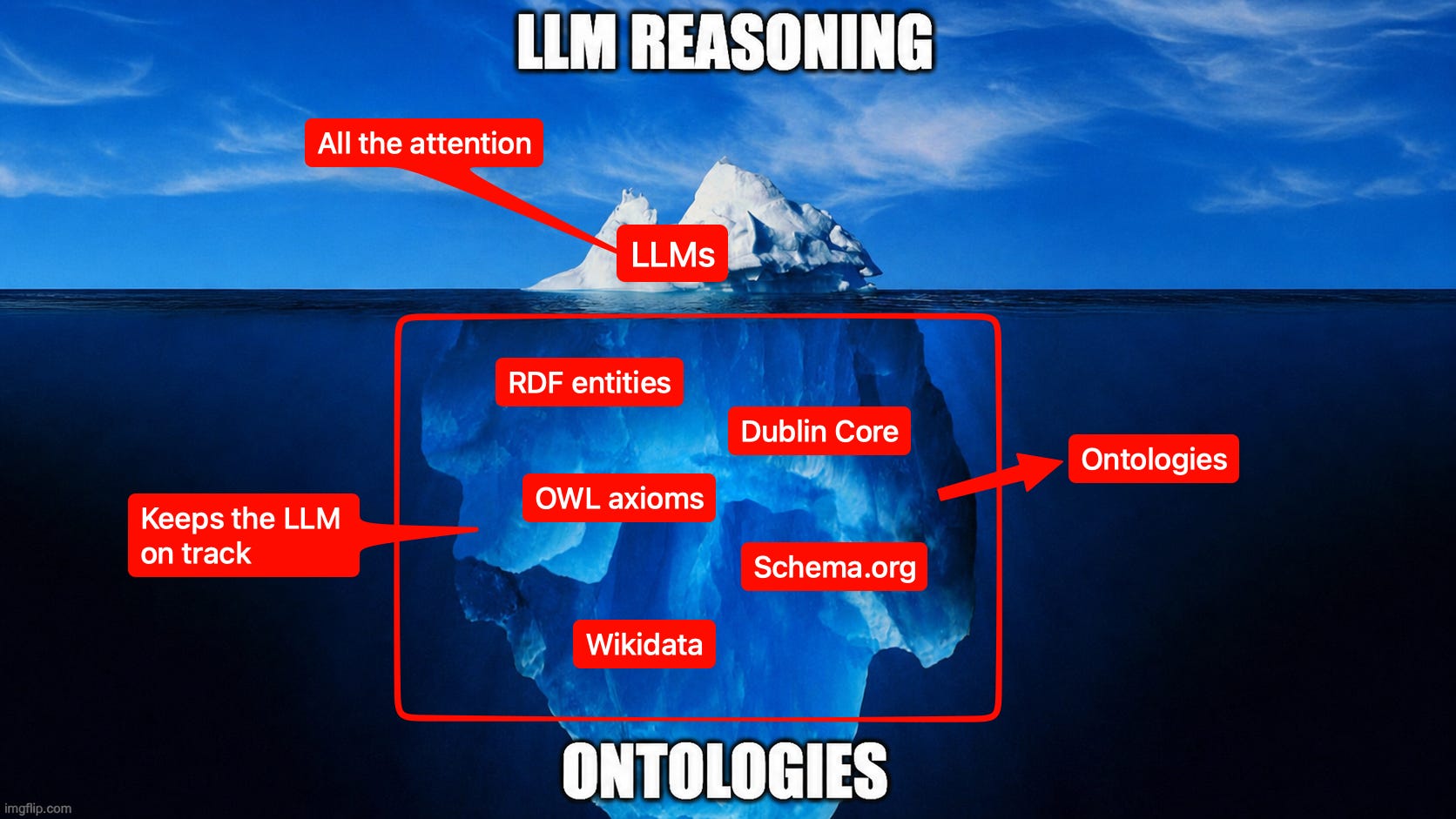
Ontologies Are So Back: Why AI Agents Are Reviving the Semantic Web
Frank Coyle at AIEWF 2026 emphasized the revival of ontologies as essential 'logical guardrails' for effective AI agents, integrating them with for better reasoning. Neo4j's Emil Eifrem highlighted three ontology types to enhance agent scalability, while Kingsley Idehen discussed the challenges and benefits of maintaining ontologies in AI systems.
![[AINews] SpaceXAI launches Grok 4.5, first Opus-class model post Cursor acquisition](https://substackcdn.com/image/fetch/$s_!8D6O!,f_auto,q_auto:good,fl_progressive:steep/https%3A%2F%2Fpbs.substack.com%2Fmedia%2FHMuQw2BXUAAJaQd.png)