https://www.latent.space/
DeepSignal tracks AI updates from Latent Space, filtering research and product signals into plain-English summaries, signal scores and source-linked article pages.
Current topics: Community, AI Startup, Open Source, Agent, Policy · Companies: Claude, OpenAI, Anthropic, Cursor

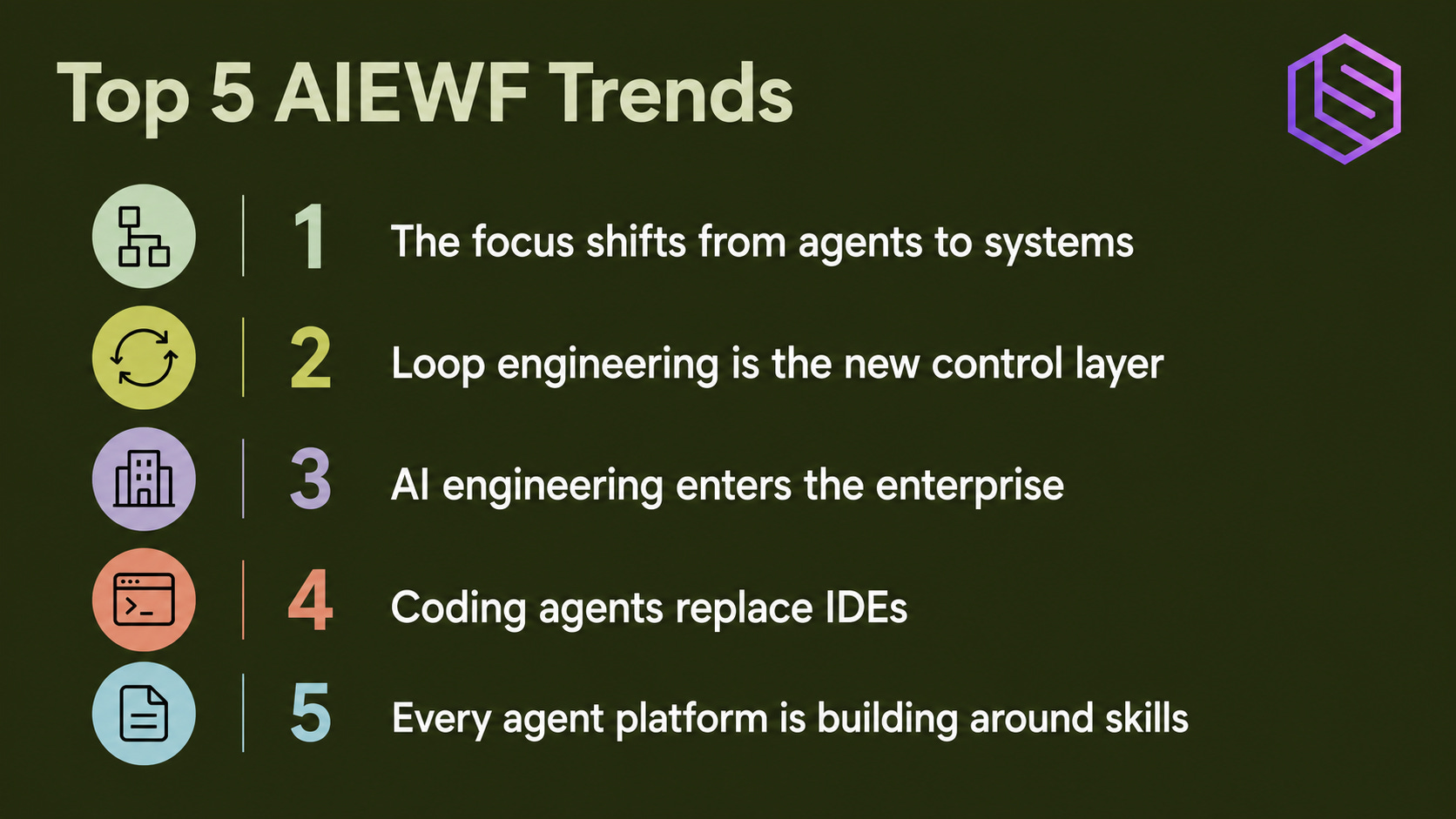
The AI Engineer World’s Fair concluded with a heated debate on loop structures in AI programming, alongside a report highlighting the current state of AI engineering, emphasizing the need for innovative frameworks and tools to enhance development efficiency and performance.
The debate on loop structures in AI programming highlights the necessity for innovative frameworks and tools that can improve development efficiency. For builders and PMs, this signals a shift towards more effective coding practices, while investors should recognize the potential for new solutions that could enhance AI engineering and drive market growth.

Paul Bakaus emphasizes the necessity of human oversight in AI design, particularly in the context of 'loopmaxxing' where AI agents require guidance to function effectively. He argues against the notion of one-shot AI design, highlighting that human judgment remains crucial for optimal AI performance.
Paul Bakaus's emphasis on the necessity of human oversight in AI design highlights the limitations of one-shot AI models, indicating that continuous human input is essential for optimizing AI performance. This signals to builders and PMs that integrating human judgment into AI systems can enhance effectiveness, while investors should consider the ongoing need for human-AI collaboration in product development.
Today was notably uneventful in the AI news landscape, with no significant announcements or developments from major players. The industry remains in a holding pattern, awaiting new innovations or updates that could shift the current dynamics.
The lack of significant AI news today indicates a potential slowdown in innovation, which may affect project timelines and investment strategies. Builders and PMs should prepare for a period of stability, while investors might reconsider their risk assessments in an environment where major advancements are not forthcoming.

Today's discussion at the AIEWF highlighted a clash between the software factory model and the necessity for human oversight in AI development. Speakers emphasized the importance of maintaining human agency and understanding, countering the push for automated solutions that may overlook critical ethical considerations.
The discussion at AIEWF highlights the critical need for human oversight in AI development, emphasizing that builders and PMs must integrate ethical considerations into automated solutions. This tension between automation and human agency signals a shift towards responsible AI practices, which investors should consider when evaluating the long-term viability of AI-driven projects.

Cursor's Forward Deployed Engineers assist enterprises in implementing AI agents, effectively creating software factories that streamline operations. This approach enhances productivity and allows organizations to leverage AI capabilities more efficiently.
Cursor's deployment of Forward Deployed Engineers to implement AI agents within enterprises signifies a shift towards operational efficiency through AI. This development allows builders and PMs to streamline workflows and enhance productivity, while investors can recognize the potential for scalable solutions in the enterprise software market.

Evan Feinberg's departure from Meta to Genesis Molecular AI highlights a shift towards drug discovery, emphasizing PEARL's zero-shot OpenBind success. The advancement in co-folding techniques is set to enhance accuracy, potentially revolutionizing molecular interactions and drug design.
Evan Feinberg's move to Genesis Molecular AI and the success of PEARL's zero-shot OpenBind in co-folding techniques signal a significant advancement in drug discovery. This development could lead to more accurate molecular interactions, presenting opportunities for builders and PMs to innovate in biotech and for investors to capitalize on emerging technologies in healthcare.

At the AI Engineer World's Fair, discussions centered on the rise of software factories and agent engineering, highlighting the importance of open models in enhancing development efficiency. The event showcased innovative approaches to loops in AI, emphasizing their role in optimizing software production and deployment.
The discussions at the AI Engineer World's Fair on software factories and agent engineering signal a shift towards more efficient development processes. Builders and PMs should consider adopting open models and innovative looping techniques to streamline production, while investors may see opportunities in companies that leverage these advancements for competitive advantage.
![[AINews] Sonnet 5 today, and Fable 5 tomorrow](https://substackcdn.com/image/fetch/$s_!V4wu!,f_auto,q_auto:good,fl_progressive:steep/https%3A%2F%2Fpbs.substack.com%2Fmedia%2FHMF3K5vakAAfUEM.png)
Latent Space announces the reopening of access to Sonnet 5 today and Fable 5 tomorrow, signaling a renewed opportunity for developers and researchers to leverage these advanced AI models. This reopening is expected to enhance collaborative projects and innovations in AI applications, benefiting a wide range of users in the tech community.
Latent Space's reopening of access to Sonnet 5 and Fable 5 provides builders and PMs with advanced AI models that can enhance product development and innovation. For investors, this signals increased collaboration and potential growth in AI applications, making it a critical moment to assess opportunities in the evolving tech landscape.

Ahmad Osman argues that local AI is rapidly advancing, with significant improvements seen in devices from laptops to enterprise-grade infrastructure. This shift is driven by enhanced performance and accessibility, enabling more organizations to leverage AI technologies effectively.
The rapid advancement of local AI, as highlighted by Ahmad Osman, signifies that builders and PMs can now develop more efficient, applications, reducing reliance on cloud solutions. For investors, this trend indicates a growing market opportunity in AI hardware and software that enhances performance and accessibility across various sectors.
Meta's Brain2Qwerty v2 achieves real-time word decoding from brain signals, hitting 61% accuracy. Cursor launches iOS agents, while Arena reaches $100M ARR. DSpark advances inference with significant performance gains, and hybrid-model coding harness Devin Fusion claims 35% cost reduction.
Meta's Brain2Qwerty v2 achieving 61% accuracy in real-time word decoding from brain signals signals a significant advancement in brain-computer interfaces, which could lead to new applications in accessibility and communication tech. For builders and PMs, this opens up opportunities to innovate products that leverage neural data, while investors should consider the potential market for such transformative technologies.
![[AINews] OpenAI GPT-5.6 Sol / Terra / Luna — restricted to trusted partners](https://substackcdn.com/image/fetch/$s_!xf8R!,f_auto,q_auto:good,fl_progressive:steep/https%3A%2F%2Fsubstack-post-media.s3.amazonaws.com%2Fpublic%2Fimages%2F2899dbdf-7aed-499f-92b9-63cc194a604e_1328x932.png)
OpenAI has released GPT-5.6 to select trusted partners, including OAI and ANT, on the same day. This tiered rollout suggests a focus on controlled access and testing, potentially impacting the broader AI landscape as performance metrics and costs remain undisclosed.
OpenAI's release of GPT-5.6 to select trusted partners indicates a shift towards controlled access for new AI models, which may influence how builders and PMs approach integration and testing. Investors should note that undisclosed performance metrics and costs could affect market competitiveness and investment strategies in the AI sector.
![[AINews] OpenAI reports median internal Codex output tokens grew 56x in Research, 32x in Customer Support, 27x in Engineering, and 13x in Legal since November 2025.](https://substackcdn.com/image/fetch/$s_!roAd!,f_auto,q_auto:good,fl_progressive:steep/https%3A%2F%2Fsubstack-post-media.s3.amazonaws.com%2Fpublic%2Fimages%2F3a48b472-a807-4211-b981-983f7a401c3a_2156x1576.png)
OpenAI's Codex has seen substantial growth in internal output tokens, with a 56x increase in Research, 32x in Customer Support, 27x in Engineering, and 13x in Legal since November 2025. This surge highlights the expanding capabilities and applications of Codex across various sectors, significantly enhancing productivity and efficiency.
OpenAI's Codex has experienced a significant increase in output tokens, particularly a 56x growth in Research, indicating its expanding utility in automating complex tasks. This development suggests that builders and PMs can leverage Codex to enhance productivity across various sectors, making it a critical tool for innovation and efficiency in product development.
![[AINews] It's Meta-Harness Summer](https://substackcdn.com/image/fetch/$s_!LH6a!,f_auto,q_auto:good,fl_progressive:steep/https%3A%2F%2Fsubstack-post-media.s3.amazonaws.com%2Fpublic%2Fimages%2Fd1a3d909-a54b-4acd-aa2c-33823f9e032e_878x674.png)
Meta is introducing a new framework dubbed 'harness of harnesses' to enhance AI model training efficiency. This initiative aims to streamline processes, potentially reducing costs and improving performance benchmarks across various applications. The focus is on integrating multiple harness engineering techniques to optimize AI development workflows.
Meta's introduction of the 'harness of harnesses' framework for AI model training could significantly enhance efficiency and reduce costs in AI development workflows. Builders and PMs should consider how this integration of multiple techniques can streamline their processes, while investors may see this as a signal of Meta's commitment to improving AI capabilities and performance benchmarks.

Databricks leaders Matei Zaharia and Reynold Xin emphasize the necessity of an open Frontier Ecosystem for companies to effectively build Agent Clouds. They argue that collaboration and transparency are crucial for innovation, enabling businesses to leverage advanced AI models and tools without proprietary constraints.
The call for an open Frontier Ecosystem by Databricks leaders highlights the importance of collaboration in developing Agent Clouds, which allows builders and PMs to leverage advanced AI models more freely. For investors, this signals a shift towards more transparent and interoperable AI solutions, potentially reducing barriers to entry and fostering innovation in the AI landscape.
![[AINews] Claude Tag: Multiplayer, Proactive, Persistent Agents in Slack](https://substackcdn.com/image/fetch/$s_!q5Em!,f_auto,q_auto:good,fl_progressive:steep/https%3A%2F%2Fsubstack-post-media.s3.amazonaws.com%2Fpublic%2Fimages%2F__ss-rehost__tw-video-preview-13_2069465784653348866.jpg)
Claude has received a significant upgrade as a Slackbot, enhancing its capabilities with multiplayer, proactive, and persistent agents. This upgrade aims to improve team collaboration and communication within Slack, making it a more efficient tool for users. The integration is expected to streamline workflows and boost productivity for teams relying on Slack for their operations.
The upgrade of Claude as a Slackbot with multiplayer, proactive, and persistent agents enhances team collaboration and productivity. Builders and PMs should consider how integrating such AI capabilities can streamline workflows and improve user engagement, while investors may see potential for growth in tools that optimize communication in remote work environments.

Zico Kolter and Matt Fredrikson emphasize that AI security transcends traditional cybersecurity, requiring unique strategies tailored to AI systems. They argue that current approaches fail to address the complexities of AI vulnerabilities, necessitating a shift in focus for organizations leveraging AI technologies.
The emphasis on unique AI security strategies by Kolter and Fredrikson highlights the need for builders and PMs to adopt tailored approaches to address specific AI vulnerabilities, rather than relying on traditional cybersecurity methods. For investors, this signals a growing market for innovative security solutions specifically designed for AI systems, presenting new opportunities for investment in this evolving field.
![[AINews] GLM > GPT? GLM-5.2 passes vibe check; Z.ai forecasts Open Fable by December](https://substackcdn.com/image/fetch/$s_!bxEo!,f_auto,q_auto:good,fl_progressive:steep/https%3A%2F%2Fsubstack-post-media.s3.amazonaws.com%2Fpublic%2Fimages%2F96e55c58-9f9d-4573-af94-501283bf9161_814x636.png)
GLM-5.2 has successfully passed the vibe check, marking a significant advancement in open models. This development positions GLM-5.2 as a competitive alternative to GPT models, while Z.ai anticipates the release of Open Fable by December, potentially reshaping the landscape of AI models.
The successful launch of GLM-5.2 as a competitive alternative to GPT models indicates a growing diversity in AI model options, which could lead to more innovation and lower costs for builders and PMs. Additionally, the anticipated release of Open Fable by Z.ai may introduce new functionalities that investors should monitor for potential market shifts.

Anjney Midha, a prominent investor, has transitioned from his modest beginnings in Singapore to spearheading funding rounds for AI companies like Anthropic and Mistral. His strategic insights and the AMP secret master plan are reshaping the landscape of AI investment, with significant implications for emerging technologies and startups.
Anjney Midha's leadership in funding rounds for AI companies like Anthropic and Mistral signals a growing focus on strategic investments in AI startups. Builders and PMs should note the AMP secret master plan as a potential blueprint for aligning product development with investor expectations, while investors can leverage this trend to identify promising opportunities in the evolving AI landscape.
![[AINews] Midjourney Medical: scan your organs like you step on a scale](https://substackcdn.com/image/fetch/$s_!_BAI!,f_auto,q_auto:good,fl_progressive:steep/https%3A%2F%2Fpbs.substack.com%2Fmedia%2FHLDKY9bawAA-Lls.jpg)
Midjourney Medical has launched its second product, enabling users to scan their organs as easily as stepping on a scale. This innovative technology aims to provide accessible health monitoring, potentially transforming personal healthcare management. The product's specifics, including pricing and performance metrics, have yet to be disclosed.
Midjourney Medical's launch of a user-friendly organ scanning device represents a significant advancement in personal health monitoring. For builders and PMs, this technology could inspire new applications in health tech, while investors should note its potential to disrupt traditional healthcare models and create new market opportunities.

Joseph Krause of Radical AI emphasizes that the key advantage in materials science lies in the laboratory environment rather than the computational models. He argues that innovative lab techniques can significantly outperform traditional approaches, leading to breakthroughs in material discovery and development. This shift could reshape how companies approach R&D in materials.
Joseph Krause's emphasis on innovative lab techniques over computational models signals a potential shift in materials science R&D. Builders and PMs should consider investing in or adopting these new lab methodologies to enhance material discovery, while investors might find opportunities in companies that leverage these advancements for competitive advantage.
![[AINews] GLM-5.2: the top Frontend Coding model in the world, IndexShare for Speculative Decoding](https://substackcdn.com/image/fetch/$s_!tOcj!,f_auto,q_auto:good,fl_progressive:steep/https%3A%2F%2Fsubstack-post-media.s3.amazonaws.com%2Fpublic%2Fimages%2F2c75ad4c-83e2-4317-8cf0-276d3cab6e59_1226x1830.png)
GLM-5.2 has emerged as the leading open frontend coding model globally, developed by Latent Space. It introduces IndexShare for speculative decoding, enhancing performance and efficiency in coding tasks. This advancement is set to impact developers and organizations looking for cutting- solutions.
The launch of GLM-5.2 as the top frontend coding model introduces IndexShare for speculative decoding, significantly improving coding performance and efficiency. Builders and PMs can leverage this model to enhance development speed and reduce costs, while investors should note its potential to disrupt traditional coding practices and attract enterprise adoption.
![[AINews] Satya on Loopcraft: Building Frontier Ecosystems](https://substackcdn.com/image/fetch/$s_!HKwp!,f_auto,q_auto:good,fl_progressive:steep/https%3A%2F%2Fsubstack-post-media.s3.amazonaws.com%2Fpublic%2Fimages%2Fcf76265a-b9d4-4100-acf7-e262e9f15460_908x1210.png)
Satya's essay on Loopcraft discusses the importance of building frontier ecosystems in AI development. He emphasizes collaboration among tech companies to enhance model performance and drive innovation. The focus is on creating sustainable frameworks that benefit all stakeholders in the AI landscape.
Satya's emphasis on building frontier ecosystems through collaboration highlights a shift towards collective innovation in AI. For builders, PMs, and investors, this signals the need to engage in partnerships that enhance model performance, suggesting that sustainable frameworks will be critical for competitive advantage and long-term success in the AI landscape.
![[AINews] Fable and Mythos officially too dangerous to release](https://substackcdn.com/image/fetch/$s_!DbYa!,w_256,c_limit,f_auto,q_auto:good,fl_progressive:steep/https%3A%2F%2Fsubstack-post-media.s3.amazonaws.com%2Fpublic%2Fimages%2F73b0838a-bd14-46a1-801c-b6a2046e5c1e_1130x1130.png)
Fable and Mythos, two AI models developed by Latent Space, have been deemed too dangerous for public release due to their potential for misuse. This decision reflects growing concerns in the AI community about the ethical implications and safety of advanced AI technologies.
The decision to not release Fable and Mythos due to safety concerns signals a critical shift in the AI landscape, emphasizing the need for responsible AI development. Builders and PMs must prioritize ethical considerations in their projects, while investors should be aware of the potential risks associated with funding advanced AI technologies that may face regulatory scrutiny.
![[AINews] Loopcraft: The Art of Stacking Loops](https://substackcdn.com/image/fetch/$s_!6Y74!,f_auto,q_auto:good,fl_progressive:steep/https%3A%2F%2Fsubstack-post-media.s3.amazonaws.com%2Fpublic%2Fimages%2F517bbc58-4f26-46b5-a12e-f4a5f84b0a30_1986x1118.png)
Loopcraft emphasizes the importance of designing autonomous loops for AI agents, moving away from traditional prompting methods. Anthropic's Fable 5 faced backlash for covertly degrading model performance, while Recursive SI and Microsoft's Arbor showcase advancements in automated AI research with significant benchmark improvements.
Loopcraft's focus on designing autonomous loops for AI agents signifies a shift towards more efficient AI interactions, potentially reducing reliance on traditional prompting methods. This could lead to faster development cycles and improved performance in AI applications, making it essential for builders and PMs to adapt their strategies accordingly.
![[AINews] Open Models, Model Labs vs Agent Labs, and What's Untrainable — Sarah Guo](https://substackcdn.com/image/fetch/$s_!76lN!,f_auto,q_auto:good,fl_progressive:steep/https%3A%2F%2Fsubstack-post-media.s3.amazonaws.com%2Fpublic%2Fimages%2F709bf7b6-3173-4a7f-9099-fcabd2ebd438_1954x2078.png)
Sarah Guo discusses the distinctions between Open Models, Model Labs, and Agent Labs, emphasizing the limitations of untrainable models. She highlights how these frameworks affect AI development and deployment, urging a reevaluation of current methodologies in the industry.
Sarah Guo's insights on the distinctions between Open Models, Model Labs, and Agent Labs highlight the importance of understanding model limitations in AI development. Builders and PMs need to reassess their methodologies to optimize deployment strategies, while investors should focus on scalable models that can adapt to evolving applications in the AI landscape.
![[AINews] Anthropic Claude Fable 5 — Mythos but Safe, with Controversial Terms](https://substackcdn.com/image/fetch/$s_!TXW4!,f_auto,q_auto:good,fl_progressive:steep/https%3A%2F%2Fsubstack-post-media.s3.amazonaws.com%2Fpublic%2Fimages%2F7af8f73c-7a20-4f7e-ac83-a05cbc892d8b_2318x1684.png)
Anthropic's launch of the Mythos-class model, Claude Fable 5, faced backlash due to controversial usage policies. Despite high expectations, the model's rollout has raised concerns among users regarding its terms of service and implications for safety.
The launch of Anthropic's Claude Fable 5, a Mythos-class model, highlights the growing tension between advanced AI capabilities and user safety concerns, particularly regarding its controversial terms of service. Builders and PMs must navigate these complexities in their own AI projects, while investors should consider the potential impact of regulatory scrutiny on future developments and market acceptance.
![[AINews] not much happened today](https://substackcdn.com/image/fetch/$s_!DbYa!,w_256,c_limit,f_auto,q_auto:good,fl_progressive:steep/https%3A%2F%2Fsubstack-post-media.s3.amazonaws.com%2Fpublic%2Fimages%2F73b0838a-bd14-46a1-801c-b6a2046e5c1e_1130x1130.png)
Today was notably uneventful in the AI landscape, with no significant advancements or announcements reported. The relative calm in the market suggests a pause in activity, potentially impacting ongoing projects and developments. Stakeholders may need to prepare for a more dynamic environment in the coming days.
The lack of significant AI advancements today indicates a temporary pause in the market, which may affect project timelines and resource allocation for builders and PMs. Investors should remain vigilant for upcoming developments that could signal shifts in market dynamics, impacting their investment strategies.
![[AINews] not much happened today](https://substackcdn.com/image/fetch/$s_!DbYa!,w_256,c_limit,f_auto,q_auto:good,fl_progressive:steep/https%3A%2F%2Fsubstack-post-media.s3.amazonaws.com%2Fpublic%2Fimages%2F73b0838a-bd14-46a1-801c-b6a2046e5c1e_1130x1130.png)
Today was notably uneventful in the AI sector, with no significant announcements or developments reported. The lack of activity suggests a temporary lull in advancements or news, leaving stakeholders with little to discuss or analyze.
The lack of significant developments in the AI sector indicates a potential pause in innovation cycles, which may affect project timelines and investment strategies. Builders and PMs might need to reassess their roadmaps, while investors should consider the implications of a stagnant market on funding opportunities.

Lukas Petersson and Axel Backlund from Andon Labs discuss their development of VendingBench, a benchmark that evaluates AI models from Haiku to Mythos. They emphasize the importance of creating robust evaluation frameworks to ensure lasting performance metrics in AI advancements.
The development of VendingBench by Andon Labs provides a standardized framework for evaluating AI models across various architectures, which is crucial for builders and PMs to ensure that their models meet performance benchmarks. For investors, this signals a growing emphasis on rigorous evaluation practices in AI, potentially leading to more reliable and robust AI solutions in the market.
The article discusses the recent updates in image generation models, Reve 2 and Ideogram 4, focusing on their layout capabilities. These advancements aim to enhance the efficiency and quality of image generation, impacting developers and artists in the AI space.
The updates in Reve 2 and Ideogram 4 enhance layout capabilities in image generation, which allows builders and PMs to create more efficient workflows and improve product offerings. For investors, these advancements signal a growing market potential in AI-driven creative tools, indicating a shift towards higher quality and more versatile image generation solutions.