Bringing GPT-Rosalind to academic research labs
Quick Answer
OpenAI launches the Rosalind Academic Plan, providing eligible academic labs with free access to GPT-Rosalind for up to 30 users over 12 months, aimed at enhancing life sciences research.
Quick Take
This initiative supports scientific discovery in areas like drug design and genomics, fostering collaboration between AI tools and researchers.
Key Points
- Eligible labs can receive up to 30 free GPT-Rosalind seats for 12 months.
- Access to advanced OpenAI models is included, subject to usage limits.
- Research data shared is not used for model training by default.
- The plan aims to accelerate discoveries in drug design and genomics.
- Responsible access includes verification of institutions and researchers.
DeepSignal Analysis
What happened
OpenAI has launched the Rosalind Academic Plan, allowing eligible academic labs in the U.S. to access GPT-Rosalind for free for up to 30 users over 12 months. This initiative aims to enhance research in life sciences, including drug design and genomics, by integrating AI tools with scientific expertise.
Key evidence
- Eligible academic labs can receive up to 30 Business Standard seats at no cost for 12 months, with access to GPT-Rosalind subject to trusted-access approval.
- The Rosalind Academic Plan is available to academic labs at U.S. universities, with applications managed by principal investigators (PIs) and lab leads.
- Research data shared through the Rosalind Academic Plan is not used to train OpenAI's models by default, ensuring privacy for participating labs.
Why it matters
This initiative could significantly impact life sciences research by providing researchers with advanced AI tools, potentially accelerating discoveries in critical areas like medicine and biotechnology. By lowering access barriers, OpenAI aims to foster collaboration between AI and scientific inquiry, which could lead to breakthroughs that benefit society at large.
📖 Reader Mode
~5 min readWe’re introducing the Rosalind Academic Plan to help more academic scientists access GPT‑Rosalind, our dedicated life sciences model, which combines frontier reasoning with Rosalind workbench(opens in a new window) that enables specialized tool orchestration across medicinal chemistry, genomics, wet-lab assistance, and other scientific applications. Eligible labs can receive up to 30 Business Standard seats at no cost for up to 12 months, with access to GPT‑Rosalind subject to trusted-access approval.
Academic research creates knowledge that entire fields build on. Work that begins with a fundamental question about biology can eventually change how we diagnose disease, develop medicines, or grow food. But those advances depend on scientists having the resources to explore ideas, test them, and share what they learn.
Accelerating scientific discovery is central to OpenAI’s mission of ensuring that artificial general intelligence benefits all of humanity. With this plan, we’re investing in the scientists doing that foundational work—helping more labs combine their expertise and judgment with AI tools built for life sciences research.
Supporting the research behind future breakthroughs
Many of the advances we rely on today grew out of years of basic research.
The Human Genome Project helped launch modern genomics, transforming medicine, diagnostics, and biotechnology.
Curiosity-driven work on bacterial immune systems led to CRISPR-Cas9, which revolutionized genome editing and is now advancing research in cancer, inherited disease, agriculture, and biotechnology. Decades of university research on mRNA also laid the groundwork for COVID-19 vaccines and a new generation of vaccines and therapies.
Academic research has always laid the groundwork for advances in medicine and biotechnology. By helping more scientists combine their scientific expertise and judgment with the advanced specialized reasoning of GPT‑Rosalind, we hope to support discoveries whose benefits reach far beyond the lab.
How academic labs are using GPT‑Rosalind
OpenAI is committed to enabling academic researchers to pursue their scientific ambitions. Distinguished academic labs are already exploring how GPT‑Rosalind can support work ranging from protein design to understanding neurodegeneration. These examples show where researchers are applying the model within their scientific workflows.
1 of 3
What the plan includes
With the new Rosalind Academic Plan, academic researchers can bring GPT‑Rosalind and Rosalind Workbench to their lab with greater flexibility and harness frontier model intelligence for scientific research.
Eligible labs receive:
Up to 30 Business Standard seats at $0 per user per month for up to 12 months.
Access to all commercially available frontier OpenAI models, subject to plan usage limits.
Access to GPT‑Rosalind following trusted-access approval.
Research data shared through the Rosalind Academic Plan is not used to train our models by default.
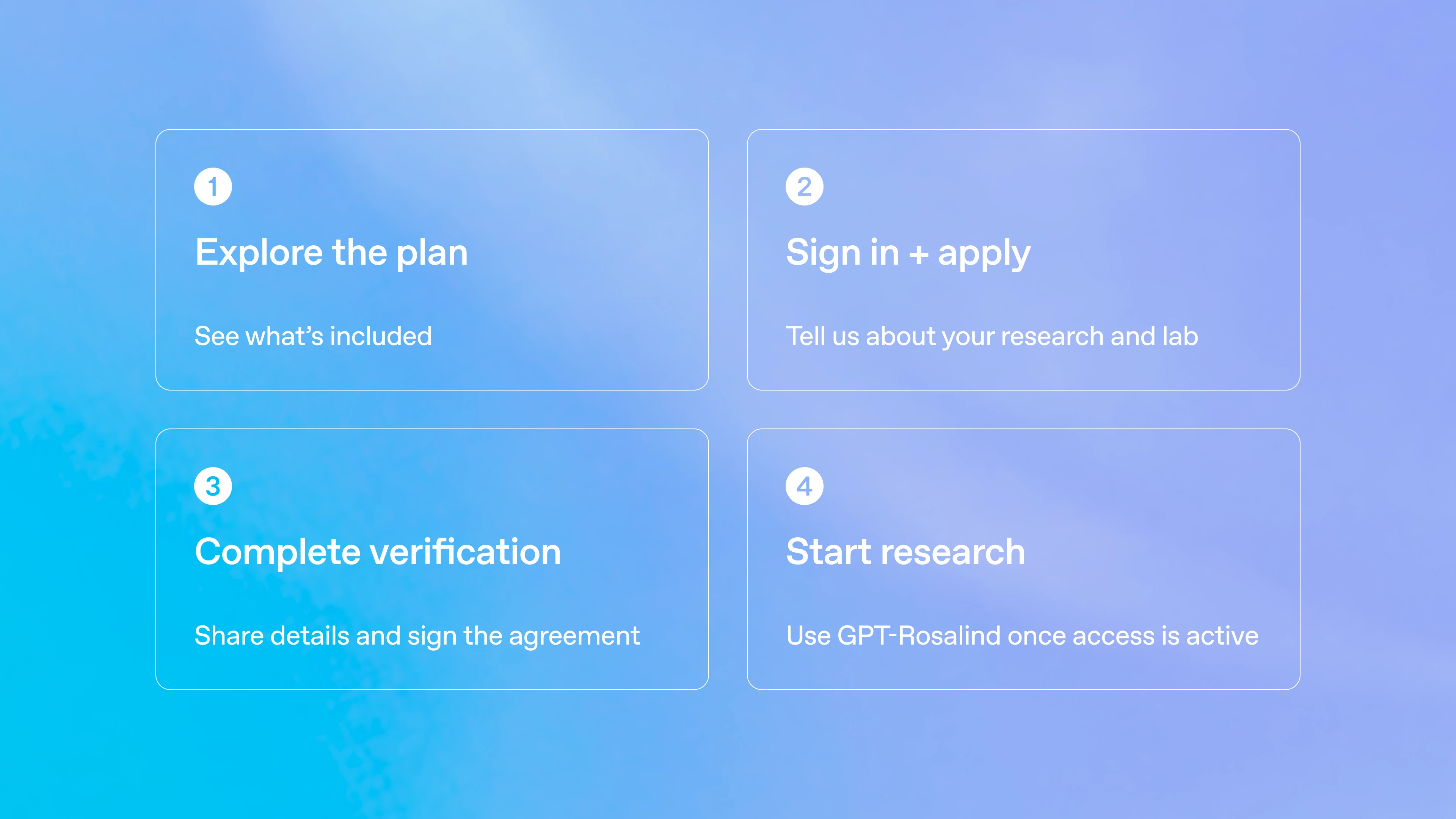
Build for life sciences research
GPT‑Rosalind is a specialized life sciences model designed to support deeper reasoning on complex biological questions. Through trusted access, approved researchers can use it to investigate sensitive scientific questions within safeguards designed for legitimate research.
Areas of research include:

Drug and protein design
Designing candidate drugs, therapeutic proteins, peptides, and enzymes, and optimizing their molecular interactions, selectivity, stability, and suitability for development.
Card 1 of 7: Drug and protein design
Apply on behalf of your lab
The Rosalind Academic Plan is currently available to academic labs at U.S. universities. PIs and lab leads at universities without an OpenAI Enterprise agreement can apply on behalf of their labs through our trusted access process. Labs at universities with an existing agreement must apply through their university’s Enterprise access process.
Once approved, PIs and lab leads can activate free access to GPT‑Rosalind for up to 30 named members, alongside the other OpenAI frontier models included in the plan. API access is not included at this time. Verified PIs and lab leads manage member permissions and are responsible for their lab’s approved use.
Get started with GPT‑Rosalind
Choose the application path for your lab or organization.
GPT‑Rosalind access is subject to approval.
Learn more about eligibility, application requirements, and getting started in our help center guide(opens in a new window).
Responsible access for scientific research
Before activating access, we:
Verify the institution’s legitimacy and the PI or lab lead’s identity
Review the lead’s professional background, institutional appointment, and authority to oversee lab access
Assess the lab’s institutional affiliation, research activities, and intended use
Establish clear responsibilities for the lab lead and a designated institutional safety contact
Safeguards continue after activation through monitoring and enforcement. For registered high-sensitivity use cases, our safety checks account for the approved research context. When questions arise, we may follow up with researchers to clarify the work and confirm authorization. This approach is designed to detect potential misuse while accounting for legitimate research context and reducing unnecessary interruptions to authorized work.
Specialized intelligence for complex scientific questions
Get started
We’re starting with academic labs as part of a broader effort to put useful AI tools in the hands of more scientists. By lowering the cost of access, we hope to give more researchers room to pursue ideas whose benefits could reach far beyond their own labs—from a clearer understanding of disease to better treatments and more resilient food systems.
Those advances will come from scientists asking important questions and doing the work to answer them. We want to help more of them do that work.
If you’re affiliated with an academic lab, learn more about the Rosalind Academic Plan and check whether you’re eligible(opens in a new window).
— Originally published at openai.com
Want this in your inbox every morning?
Daily brief at your local 8am — bilingual EN/中文, free.
More from OpenAI Blog
See more →Scientific computing in the age of agentic AI
AI agents are transforming scientific computing by streamlining software development, enabling researchers to focus on discovery. Projects using Codex and Claude Code report accelerated development and improved maintenance, though challenges in validating AI outputs remain. Long-term stewardship of research software is crucial to ensure reliability and reproducibility.