Teaching students to think and learn through questions
Quick Answer
OpenAI's new AI for Educators course, now available in Brazilian Portuguese, empowers teachers to integrate AI into lesson planning and assessments.
Quick Take
The innovative Study Mode feature encourages active learning through guided questioning, enhancing student engagement and understanding.
Key Points
- AI for Educators course launched in Brazilian Portuguese on OpenAI Academy.
- Study Mode allows step-by-step exploration with guided questions and checks for understanding.
- Teachers can assess student reasoning through tailored questions in Study Mode.
- The campaign humorously highlights the evolving teacher-student relationship in an AI-driven world.
- Teachers are encouraged to experiment with these tools to enhance their teaching methods.
DeepSignal Analysis
What happened
OpenAI has launched the AI for Educators course in Brazilian Portuguese, aimed at teachers across various educational levels. The course focuses on integrating AI into lesson planning and assessments while maintaining educators' pedagogical judgment. Additionally, the new Study Mode feature promotes active learning through guided questioning.
Key evidence
- The AI for Educators course is now available in Brazilian Portuguese on OpenAI Academy, targeting educators in primary, secondary, and higher education.
- Study Mode, developed with input from educators and experts, allows students to engage with subjects step by step through questions and checks for understanding.
- Teachers can utilize Study Mode to assess student understanding and tailor lessons based on student responses, enhancing the educational experience.
Why it matters
This initiative highlights the evolving role of educators in a technology-driven learning environment. By providing tools that encourage active participation and critical thinking, OpenAI aims to support teachers in enhancing student engagement and understanding. The integration of AI into education could reshape traditional teaching methods, making learning more interactive and personalized.
📖 Reader Mode
~2 min readOn Teachers’ Day, we celebrate those who help us learn. A good question can change the course of a lesson. It can bring an unspoken question to light, open up another way to solve a problem, or help someone recognize what they already know. Teachers do this work every day: they know their students, choose how to introduce an idea, and guide them from their first attempt to understanding.
Set in a university classroom, the campaign takes a humorous look at the changing relationship between teachers and students and celebrates the role of educators in a world with AI.
AI for Educators now available in Portuguese
Today, we are launching the AI for Educators(opens in a new window) course in Brazilian Portuguese on OpenAI Academy, OpenAI’s free learning platform. Designed for educators in primary, secondary, and higher education, the course shows how to use AI to plan lessons, create activities and assessments, and prepare communications while preserving educators’ pedagogical judgment.
Learning through active participation, step by step
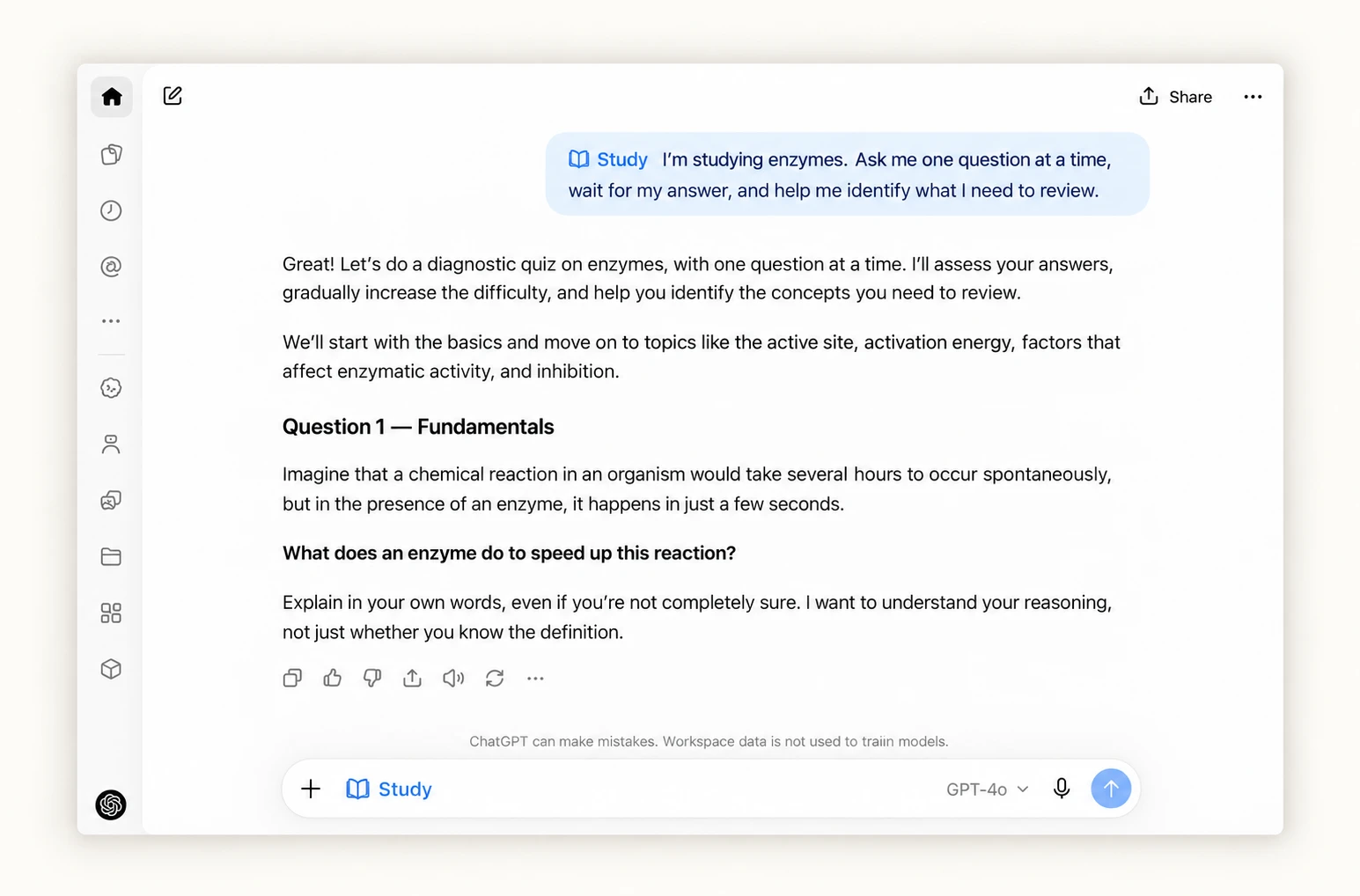
Study Mode helps you explore a subject(opens in a new window) step by step, with questions, hints, explanations, and checks for understanding. Developed in collaboration with teachers, scientists, and experts in pedagogy, the feature aims to encourage active participation and reflection on one’s own reasoning.
To turn on Study Mode, select Study from the tools menu in ChatGPT.
A student reviewing biology, for example, might ask: “I’m studying enzymes. Ask me one question at a time, wait for my answer, and help me identify what I need to review.”
Teachers can also try Study Mode with subjects they know well, looking at whether the questions encourage reasoning and whether the explanations are appropriate for their class.
In a science lesson on evaporation, for example, a teacher might ask students to investigate why clothes dry on a clothesline. After exploring the topic with Study Mode, each student writes their own explanation and a question to discuss in class, without referring back to the conversation. The teacher can use these responses to identify what needs to be revisited with the class.
This Teachers’ Day, we invite you to experiment: explore the AI for Educators course, try Study Mode, and discover how these tools can be useful in different teaching contexts. Technology can open up new ways to learn, but it is teachers who know their students, ask the most important questions, and help turn curiosity into knowledge.
— Originally published at openai.com
Want this in your inbox every morning?
Daily brief at your local 8am — bilingual EN/中文, free.
More from OpenAI Blog
See more →Scientific computing in the age of agentic AI
AI agents are transforming scientific computing by streamlining software development, enabling researchers to focus on discovery. Projects using Codex and Claude Code report accelerated development and improved maintenance, though challenges in validating AI outputs remain. Long-term stewardship of research software is crucial to ensure reliability and reproducibility.