Daily Brief
Today's AI brief, summarized in minutes.
DeepSignal — 2026-06-25
Today's 20 highest-signal stories across 5 verticals, curated by DeepSignal.
Rolling — refreshes every 2h. Locks at 02:00 UTC tomorrow.
last refreshed 109 min ago
20 stories5 verticals
Today's Highlights
10 highlights- 01Dustin: Draft-Augmented Sparse Verification for Efficient Long-Context Generation with Speculative Decoding
Dustin introduces a sparse verification framework for long-context speculative decoding, achieving a 27.85x speedup in self-attention and a 9.17x end-to-end decoding speedup on Qwen2.5-72B at 32k sequence length, with minimal accuracy loss.
- 02Curvature-Guided Mixing for MLLM Adaptation
Curvature-Guided Mixing (CGM) enhances MLLM adaptation by merging pre-trained and fine-tuned models using a second-order optimization approach. Experiments on LLaVA-1.5 and Qwen2.5VL demonstrate improved task specialization and general knowledge retention compared to existing methods. The proposed CGM and its variant CGM† show consistent performance gains across multiple downstream tasks.
Today by Vertical
5 verticalsHardware
The recent advancements in UAV technology are exemplified by OrthoTrack, a training-free system for continuous 6-DoF trajectory estimation that operates in real-time on a single GPU, as detailed in this article. This system leverages public orthophotos to provide accurate pose estimations without GPS, setting a new benchmark in UAV performance. Concurrently, the resurgence of Groq's LPU within NVIDIA's Vera Rubin platform highlights a shift towards specialized chips for AI inference, boasting an impressive SRAM bandwidth of 150 TB/s, which outperforms traditional HBM solutions, as reported in this article. The combination of these innovations signals a growing trend towards specialized hardware solutions, which presents both opportunities and challenges for builders and investors in the tech landscape.
Robotics
Recent advancements in robotics highlight a shift towards more secure and efficient automation solutions. Grab's security team has developed Palana, a Kubernetes-native platform for secure execution of autonomous AI agents, mitigating risks associated with unpredictable tool use and code writing (InfoQ AI, ML & Data Engineering). Concurrently, Techman Robot showcased scalable AI automation solutions at Automate 2026, focusing on rapid deployment and standardized quality control for manufacturers expanding in the US (Robotics Tomorrow). Additionally, Agility Robotics is set to go public through a $2.5 billion merger, marking a significant milestone for humanoid robotics in the U.S. market (Robotics Tomorrow). These developments indicate a growing emphasis on safety, efficiency, and commercial viability in robotics, presenting new opportunities for builders and investors alike.
Policy
Today's Observations
7 observations- Dustin's framework achieves 27.85x speedup in self-attention, crucial for LLM developers aiming for efficiency in long-context tasks. [1]
- Curvature-Guided Mixing shows consistent performance gains, highlighting the need for adaptive strategies in model training for AI investors. [2]
- OrthoTrack's training-free UAV trajectory estimation outperforms existing methods, indicating a shift towards real-time solutions in robotics for operators. [3]
- Yuvion VL leads in AI safety tasks, emphasizing the importance of robust safety measures for developers in multimodal AI applications. [4]
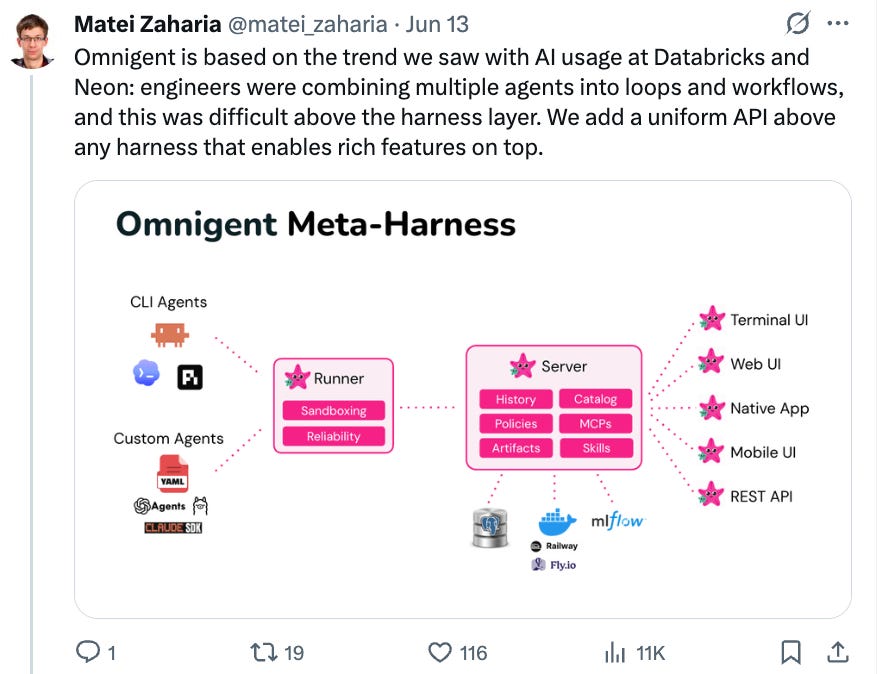
- Meta's 'harness of harnesses' aims to cut costs and boost performance, signaling a trend toward streamlined AI development for enterprise operators. [5]
- Google's Gemini 3.5 Flash can autonomously control devices, presenting new opportunities for developers in software automation and testing. [6]
- Grab's Palana platform enhances security for autonomous AI agents, underscoring the growing importance of secure infrastructure for AI operators. [7]
Featured
6 storiesarXiv cs.CL·WenHung Lee, Jian-Jia Chen, Xiaolin Lin, Pei-Shuo Wang, Chi-Chih Chang, Chun-Che Yang, Ning-Chi Huang, Grace Li Zhang, Kai-Chiang Wu
13h agoDustin: Draft-Augmented Sparse Verification for Efficient Long-Context Generation with Speculative Decoding
AI Summary
Dustin introduces a sparse verification framework for long-context speculative decoding, achieving a 27.85x speedup in self-attention and a 9.17x end-to-end decoding speedup on Qwen2.5-72B at 32k sequence length, with minimal accuracy loss.
Why Featured
The introduction of the Dustin framework for long-context speculative decoding significantly enhances the efficiency of processing large sequences, achieving a 27.85x speedup in self-attention. This development is crucial for builders and PMs focusing on real-time applications, as it allows for faster model inference with minimal accuracy loss, making it more feasible for investors to support scalable AI solutions.
References
20 articles- 01Dustin: Draft-Augmented Sparse Verification for Efficient Long-Context Generation with Speculative Decoding— arXiv cs.CL
- 02Curvature-Guided Mixing for MLLM Adaptation— arXiv cs.CV
- 03OrthoTrack: Continuous 6-DoF UAV Trajectory Estimation Anchored in Public Orthophotos— arXiv cs.CV
- 04Yuvion VL: A Multimodal Foundation Model for Adversarial Content and AI Safety— arXiv cs.CV
- 05[AINews] It's Meta-Harness Summer— Latent Space
- 06