DeepSignal
© 2026 DeepSignal · About
  • All
  • Featured
  • Latest
  • Guides
  • Daily
  • Weekly
  • Saved
  • Subscribe
  • Sources
  • About
  • Feedback
Sign in
  • Featured
  • Latest
  • Guides
  • Daily
  • Weekly

    Daily Brief

    Today's AI brief, summarized in minutes.

    Subscribe
    2026-07-102026-07-092026-07-082026-07-072026-07-062026-07-052026-07-042026-07-032026-07-022026-07-01

    DeepSignal — 2026-07-09

    Today's 20 highest-signal stories across 3 verticals, curated by DeepSignal.

    Finalised. Subscribers will receive this shortly.
    20 stories3 verticals
    Top stories
    1. Synthetic Data Generation for Financial AI Research with NVIDIA NeMoSignal 87
    2. OpenAI launches its new family of models with GPT-5.6Signal 86
    3. Popular open source AI developer tool Ollama raises $65M, grows to nearly 9M usersSignal 85
    Key companies
    OpenAI, Anthropic, AWS, Copilot, Cursor
    Key topics
    AI Coding, LLM, Research, Open Source, Inference
    Why it matters
    Today's AI news clusters around AI Coding, LLM, Research, with major signals from OpenAI, Anthropic, AWS, showing where model, tooling, and infrastructure shifts are shaping product decisions.

    Today's Highlights

    10 highlights
    1. 01Synthetic Data Generation for Financial AI Research with NVIDIA NeMo

      NVIDIA's NeMo pipeline generates 502,536 unique financial news headlines in 82 iterations, addressing data imbalance in financial NLP. The iterative approach uses semantic deduplication and category-weighted sampling to enhance diversity and relevance in generated content.

    2. 02OpenAI launches its new family of models with GPT-5.6

      OpenAI has launched GPT-5.6, featuring three models: Sol, Terra, and Luna, with Sol being 54% more token efficient for coding tasks. The models excel in cybersecurity and enterprise applications, outperforming competitors like Anthropic's Fable in benchmarks. Pricing starts at $1 for Luna and goes up to $30 for Sol per million tokens.

    Today by Vertical

    3 verticals

    Hardware

    Recent advancements in hardware and AI tools are reshaping the landscape for developers. NVIDIA's NeMo pipeline has generated over 500,000 unique financial news headlines, addressing data imbalance in financial NLP through iterative methods that enhance content diversity and relevance, as detailed in the NVIDIA Developer Blog. Meanwhile, Ollama, an open-source AI tool, has successfully raised $65M in funding and attracted nearly 9 million users, allowing developers to run AI models on PCs and access cloud-hosted options via subscription, as reported by TechCrunch. Additionally, the shift towards Token billing in AI is transforming cost structures, necessitating a deeper understanding of pricing complexities, which is essential for effective budgeting, highlighted in 雷峰网芯片. Finally, the TF-Engram system enhances large language models by reducing GPU memory demands and improving performance, showcasing innovative memory integration techniques, as discussed in arXiv cs.CL. This evolution signifies a critical juncture for builders and investors focusing on cost efficiency and performance in AI development.

    Papers

    Recent studies in multimodal learning and speech processing have introduced significant advancements. The ProMoE-FL framework effectively addresses missing modalities in federated learning, outperforming existing methods on chest X-ray datasets. Meanwhile, a gradient-based alignment method for ASR models, discussed in this article, shows promise in improving alignment performance across various models without requiring modifications. Additionally, the framework for predicting item parameters from text embeddings, as detailed in this paper, emphasizes the need for careful validation in educational assessments. Collectively, these innovations highlight the ongoing evolution in machine learning techniques, suggesting that builders and investors should focus on integrating these advanced methodologies into practical applications.

    Today's Observations

    7 observations
    • NVIDIA's NeMo generates 502,536 unique headlines, crucial for financial AI developers addressing data imbalance in NLP. Diverse data enhances model training effectiveness.
    • OpenAI's GPT-5.6 Sol is 54% more token efficient, offering a competitive edge for cybersecurity firms. Lower costs per million tokens improve enterprise AI budgets.
    • Ollama's $65M funding and 9M users signal strong demand for open-source AI tools. Investors should consider the growth potential in developer-centric solutions.
    • Google's AlloyDB achieves 2,400x throughput improvements with local inference, reducing costs for enterprises. Operators should adopt this for efficient database management.
    • Meta's Muse Spark API undercuts competitors at $1.25 per million tokens, intensifying the AI pricing landscape. Developers must reassess budget allocations for AI services.
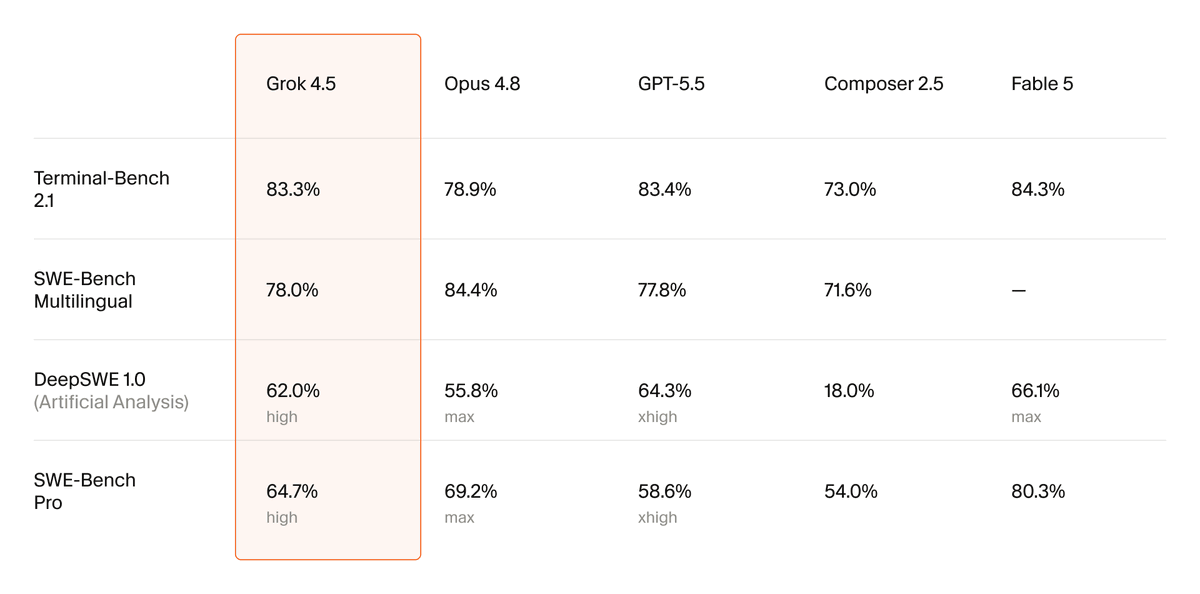
    • SpaceXAI's Grok 4.5 is 3x larger than its predecessor, priced at $2 per million tokens, offering cost-effective alternatives for coding-focused applications.
    • Understanding token billing complexities is essential as companies shift to this model. Investors must evaluate hidden costs to optimize AI budgeting.

    Featured

    6 stories
    Synthetic Data Generation for Financial AI Research with NVIDIA NeMo
    NVIDIA Developer Blog
    NVIDIA Developer Blog·Elizabeth Goodman
    8h ago
    FeaturedOriginal

    Synthetic Data Generation for Financial AI Research with NVIDIA NeMo

    AI Summary

    NVIDIA's NeMo pipeline generates 502,536 unique financial news headlines in 82 iterations, addressing data imbalance in financial NLP. The iterative approach uses semantic deduplication and category-weighted sampling to enhance diversity and relevance in generated content.

    Why Featured

    NVIDIA's NeMo pipeline generates over 500,000 unique financial news headlines, which addresses data imbalance in financial NLP. This development allows builders and PMs to access diverse training data, enhancing model performance and relevance in financial applications, while investors can leverage improved AI solutions to gain competitive advantages in the market.

    #AI Coding#GPU#Open Source#AI Startup
    4

    References

    20 articles
    1. 01Synthetic Data Generation for Financial AI Research with NVIDIA NeMo— NVIDIA Developer Blog
    2. 02OpenAI launches its new family of models with GPT-5.6— TechCrunch
    3. 03Popular open source AI developer tool Ollama raises $65M, grows to nearly 9M users— TechCrunch
    4. 04ProMoE-FL: Prototype-conditioned Mixture of Experts for Multimodal Federated Learning with Missing Modalities— arXiv cs.CV
    5. 05Meta's Muse Spark 1.1 API pricing squeezes OpenAI and Anthropic as the AI price war heats up— The Decoder
    6. 06
  1. 03Popular open source AI developer tool Ollama raises $65M, grows to nearly 9M users

    Ollama, an open-source AI tool, has raised $65M in Series B funding, reaching nearly 9M users. It enables developers to run open-weight AI models on PCs and offers cloud-hosted models via subscription, tracking usage by GPU time.

  2. 04ProMoE-FL: Prototype-conditioned Mixture of Experts for Multimodal Federated Learning with Missing Modalities

    ProMoE-FL introduces a Prototype-conditioned Mixture-of-Experts framework for multimodal federated learning, effectively addressing missing modalities. It outperforms existing methods on four chest X-ray datasets, demonstrating superior feature synthesis capabilities in both homogeneous and heterogeneous settings.

  3. 05Meta's Muse Spark 1.1 API pricing squeezes OpenAI and Anthropic as the AI price war heats up

    Meta's Muse Spark 1.1 API, priced at $1.25 per million input tokens, undercuts competitors like OpenAI and Anthropic, intensifying the AI price war. The model excels in multi-agent orchestration and coding tasks, leading benchmarks such as MCP Atlas and Humanity's Last Exam, while also promising significant cost efficiency for developers.

  4. 06[AINews] SpaceXAI launches Grok 4.5, first Opus-class model post Cursor acquisition

    SpaceXAI has launched Grok 4.5, a new coding-focused model that is 3x larger than Grok 4.3, priced at $2 per million input tokens. Positioned as an Opus-class model, it aims for efficiency and speed, outperforming competitors like GPT-5.6 and Opus 4.8 in cost-effectiveness.

  5. 07AlloyDB Ships Proxy Models That Replace LLM Calls with Local Inference Inside the Database

    Google's AlloyDB AI functions now allow direct LLM calls within SQL, achieving 2,400x throughput improvements via smart batching and 23,000x with optimized proxy models. The proxy model architecture enables local inference, significantly reducing costs and latency for database queries.

  6. 08Token账单迷雾:当每百万Token多少钱变成「比价陷阱」

    The rise of Token billing in AI has transformed costs into operational expenses, with prices varying significantly due to factors like model efficiency, energy costs, and contract terms. As companies shift from GPU hours to Token-based billing, understanding the hidden complexities behind Token pricing becomes crucial for effective budgeting.

  7. 09Gradient-Based Speech-to-Text Alignment for Any ASR Model: From CTC to Speech LLMs

    This study introduces a gradient-based alignment method applicable to any differentiable ASR model, including speech LLMs, without requiring training or model modifications. Evaluated across sixteen models, it shows promising alignment performance, particularly in scenarios where native alignments are weak, although it incurs a cost of one backward pass per token.

  8. 10From Text to Parameters: Predicting Item Parameters from Embedding Regularization with Reliability and Design Ceilings

    This study introduces a framework for predicting item parameters from text embeddings, achieving a predictive R squared of 0.53 for item difficulty in mathematics, while highlighting the limitations in predicting discrimination and pseudo guessing parameters. The findings emphasize the importance of repeated cross-validation to avoid inflated accuracy in calibration applications.

  9. AI

    The competitive landscape in AI model pricing is intensifying, particularly with Meta's introduction of the Muse Spark 1.1 API, which undercuts rivals like OpenAI and Anthropic at $1.25 per million input tokens, showcasing strengths in multi-agent orchestration and coding tasks as highlighted in benchmarks such as MCP Atlas and Humanity's Last Exam (The Decoder). Meanwhile, SpaceXAI's Grok 4.5, a coding-focused model priced at $2 per million tokens, claims to be three times larger than its predecessor and outperforms models like GPT-5.6 in efficiency (Latent Space). Additionally, Google's AlloyDB AI is revolutionizing database interactions by enabling local inference and achieving substantial throughput improvements with its proxy models (InfoQ AI, ML & Data Engineering). For builders and investors, these developments signal a critical shift towards cost-effective solutions in AI deployment.

    OpenAI launches its new family of models with GPT-5.6
    TechCrunch
    TechCrunch·Lucas Ropek
    5h ago
    FeaturedOriginal

    OpenAI launches its new family of models with GPT-5.6

    AI Summary

    OpenAI has launched GPT-5.6, featuring three models: Sol, Terra, and Luna, with Sol being 54% more token efficient for coding tasks. The models excel in cybersecurity and enterprise applications, outperforming competitors like Anthropic's Fable in benchmarks. Pricing starts at $1 for Luna and goes up to $30 for Sol per million tokens.

    Why Featured

    OpenAI's launch of GPT-5.6, particularly the Sol model's 54% increase in token efficiency for coding tasks, signifies a major advancement in AI capabilities for developers. This improvement can lead to reduced costs and enhanced performance in cybersecurity and enterprise applications, making it a critical consideration for builders and investors focused on competitive advantages in these sectors.

    #LLM#AI Coding#Security#Enterprise AI
    3
    Popular open source AI developer tool Ollama raises $65M, grows to nearly 9M users
    TechCrunch
    TechCrunch·Julie Bort
    14h ago
    FeaturedOriginal

    Popular open source AI developer tool Ollama raises $65M, grows to nearly 9M users

    AI Summary

    Ollama, an open-source AI tool, has raised $65M in Series B funding, reaching nearly 9M users. It enables developers to run models on PCs and offers cloud-hosted models via subscription, tracking usage by GPU time.

    Why Featured

    Ollama's $65M Series B funding and growth to nearly 9M users signal strong demand for open-source AI development tools, indicating a shift towards decentralized AI model deployment. Builders and PMs should consider integrating such tools to enhance flexibility and reduce reliance on proprietary solutions, while investors might see this as an opportunity in the growing AI infrastructure market.

    #GPU#Open Source#Funding#AI Startup
    1
    arXiv cs.CV
    arXiv cs.CV·Aavash Chhetri, Bibek Niroula, Eduard Vazquez, Yash Raj Shrestha, Prashnna Gyawali, Loris Bazzani, Binod Bhattarai
    23h ago
    FeaturedOriginal

    ProMoE-FL: Prototype-conditioned Mixture of Experts for Multimodal Federated Learning with Missing Modalities

    AI Summary

    ProMoE-FL introduces a Prototype-conditioned Mixture-of-Experts framework for multimodal federated learning, effectively addressing missing modalities. It outperforms existing methods on four chest X-ray datasets, demonstrating superior feature synthesis capabilities in both homogeneous and heterogeneous settings.

    Why Featured

    The introduction of ProMoE-FL, a Prototype-conditioned Mixture-of-Experts framework for multimodal federated learning, is significant as it addresses the challenge of missing modalities in data. This advancement can enhance the performance of AI models in healthcare applications, particularly in medical imaging, making them more robust and effective in real-world scenarios where data may be incomplete.

    #LLM#AI Coding#AI Startup#Enterprise AI
    3
    Meta's Muse Spark 1.1 API pricing squeezes OpenAI and Anthropic as the AI price war heats up
    The Decoder
    The Decoder·Matthias Bastian
    10h ago
    FeaturedOriginal

    Meta's Muse Spark 1.1 API pricing squeezes OpenAI and Anthropic as the AI price war heats up

    AI Summary

    Meta's Muse Spark 1.1 API, priced at $1.25 per million input tokens, undercuts competitors like OpenAI and Anthropic, intensifying the AI price war. The model excels in orchestration and coding tasks, leading benchmarks such as Atlas and , while also promising significant cost efficiency for developers.

    Why Featured

    Meta's Muse Spark 1.1 API, priced at $1.25 per million input tokens, offers a cost-effective alternative to OpenAI and Anthropic, which may lead builders and PMs to reconsider their AI strategy to optimize budgets. For investors, this pricing shift signals a competitive landscape that could impact long-term profitability and market dynamics in the AI sector.

    #Agent#AI Coding#Open Source#Funding
    3
    [AINews] SpaceXAI launches Grok 4.5, first Opus-class model post Cursor acquisition
    Latent Space
    Latent Space
    21h ago
    FeaturedOriginal

    [AINews] SpaceXAI launches Grok 4.5, first Opus-class model post Cursor acquisition

    AI Summary

    SpaceXAI has launched Grok 4.5, a new coding-focused model that is 3x larger than Grok 4.3, priced at $2 per million input tokens. Positioned as an Opus-class model, it aims for efficiency and speed, outperforming competitors like GPT-5.6 and Opus 4.8 in cost-effectiveness.

    Why Featured

    The launch of Grok 4.5 by SpaceXAI, a coding-focused model that is 3x larger than its predecessor and offers superior cost-effectiveness, signals a significant advancement in AI capabilities. Builders and PMs should consider integrating this model to enhance coding efficiency, while investors may see potential for high returns in the competitive AI landscape.

    #LLM#AI Coding#Acquisition#AI Startup
    151
    [AINews] SpaceXAI launches Grok 4.5, first Opus-class model post Cursor acquisition— Latent Space
  10. 07AlloyDB Ships Proxy Models That Replace LLM Calls with Local Inference Inside the Database— InfoQ AI, ML & Data Engineering
  11. 08Token账单迷雾:当每百万Token多少钱变成「比价陷阱」— 雷峰网芯片
  12. 09Gradient-Based Speech-to-Text Alignment for Any ASR Model: From CTC to Speech LLMs— arXiv cs.CL
  13. 10From Text to Parameters: Predicting Item Parameters from Embedding Regularization with Reliability and Design Ceilings— arXiv cs.CL
  14. 11DeLS-Spec: Decoupled Long-Short Contexts for Parallel Speculative Drafting— arXiv cs.CL
  15. 12TF-Engram: A Train-Free Engram with SSD-Backed Memory for Large Language Models— arXiv cs.CL
  16. 13Behavior Leverage Imbalance in Multi-Teacher On-Policy Distillation— arXiv cs.CL
  17. 14CoFINN: Conservation Flux Informed Neural Networks for Physics Problems Governed by Conservation Laws— arXiv cs.CV
  18. 15How did the government decide OpenAI’s frontier model was safe to release?— TechCrunch
  19. 16SynthAVE: Scalable Synthetic Labeling for E-Commerce with LLM-Arena Validation— arXiv cs.CL
  20. 17Grounding Spatial Relations in a Compact World Model: Instruction Leakage and a Goal-Free Dynamics Fix— arXiv cs.AI
  21. 18Evaluating SageMath-Augmented LLM Agents for Computational and Experimental Mathematics— arXiv cs.AI
  22. 19Physics-Audited Agentic Discovery in Scientific Machine Learning— arXiv cs.AI
  23. 20OpenAI’s GPT-5.6 Sol, Terra, and Luna are now available in GitHub Copilot— GitHub Copilot Changelog