DeepSignal
© 2026 DeepSignal · About
  • All
  • Featured
  • Latest
  • Guides
  • Daily
  • Weekly
  • Saved
  • Subscribe
  • Sources
  • About
  • Feedback
Sign in
  • Featured
  • Latest
  • Guides
  • Daily
  • Weekly

    Daily Brief

    Today's AI brief, summarized in minutes.

    Subscribe
    2026-10-082026-08-062026-08-052026-08-042026-08-032026-08-022026-08-012026-07-312026-07-302026-07-29

    DeepSignal — 2026-08-06

    Today's 20 highest-signal stories across 4 verticals, curated by DeepSignal.

    Archived draft (no subscribers received this).
    20 stories4 verticals
    Top stories
    1. Building an agentic app deployer with Amazon Bedrock and AWS LambdaSignal 85
    2. WeatherNext: AI model achieves breakthrough in forecasting cyclonesSignal 80
    3. GEB-Bench: Abstract Structures Told in Many VoicesSignal 78
    Key companies
    AWS, Amazon, Bedrock, Google, Cloudflare
    Key topics
    Agent, Inference, Research, AI Coding, Open Source
    Why it matters
    Today's AI news clusters around Agent, Inference, Research, with major signals from AWS, Amazon, Bedrock, showing where model, tooling, and infrastructure shifts are shaping product decisions.

    Today's Highlights

    10 highlights
    1. 01Building an agentic app deployer with Amazon Bedrock and AWS Lambda
      PDI Technologies developed PDI Brew, enabling non-technical employees to create web applications on AWS without developer involvement, leveraging Amazon Bedrock for AI capabilities. This agentic app deployer streamlines internal tool delivery, removing traditional bottlenecks in deployment pipelines.

    2. 02WeatherNext: AI model achieves breakthrough in forecasting cyclones

      Google DeepMind's WeatherNext AI model enhances cyclone forecasting accuracy, providing an extra day of predictive lead time. Open-sourced, it integrates global weather dynamics and historical cyclone data, achieving state-of-the-art results with a 24-hour advantage over previous models. This breakthrough aids forecasters and disaster preparedness, impacting communities globally.

    Today by Vertical

    4 verticals

    Hardware

    Recent advancements in AI hardware highlight the need for improved resource management in agentic AI workflows. A study on the architectural implications of these workflows reveals inefficiencies caused by fragmented execution across CPU-GPU boundaries, as detailed in this research from Microsoft Azure and Agora. In parallel, Mirendil's recent $100M+ partnership with Google Cloud aims to enhance self-improving AI capabilities using TPUs and Nvidia GPUs, which could significantly impact fields such as medicine and biology. Together, these developments underscore the importance of optimizing hardware utilization to support the next generation of AI applications. What this means for builders/investors is that focusing on resource efficiency will be crucial for scaling AI technologies effectively.

    Security

    Recent advancements in AI security highlight the importance of robust safety measures in large language models and AI traffic management. The introduction of DataRx, which employs a missingness-aware sampling method, significantly reduces the attack success rate of Llama3-8B-Instruct from 59.23% to 13.70% with minimal additional safety samples, emphasizing the need for data-centric defenses in AI applications (DataRx - [f2e34e54-cf1b-4de2-87e9-d38e2a134018]). Concurrently, AWS has implemented rate limiting for the Amazon Bedrock AgentCore gateway, allowing users to define rules that enhance service availability during traffic spikes (rate limits - [aade4cfc-e629-4703-8274-8134945c225b]). Furthermore, new capabilities in AgentCore, including temporal policies and the Dogwood policy language, provide organizations with tools to manage agent behaviors and ensure compliance, addressing critical trust and security challenges in AI adoption (AgentCore - [840f0818-508f-4a44-9457-2de1ca575c5e]). What this means for builders/investors is the growing necessity for integrating advanced security measures into AI systems to mitigate risks and enhance trust.

    Today's Observations

    7 observations
    • PDI Brew empowers non-technical staff to build apps, reducing deployment bottlenecks—crucial for enterprises seeking agility. [1]
    • WeatherNext's cyclone forecasting gains an extra day of lead time, enhancing disaster preparedness—vital for communities in cyclone-prone areas. [2]
    • GEB-Bench reveals models struggle with cross-voice mapping, indicating a need for improved AI training methodologies—important for developers focusing on multi-modal applications. [3]
    • Interoceptive Attention boosts survival rates in AI agents by over 100%, suggesting a paradigm shift in resource allocation strategies for AI developers. [4]
    • Tesla and SpaceX's $16.8B chip factory aims to meet surging AI and robotics demands—investors should monitor the implications for semiconductor supply chains. [9]
    • AWS's rate limiting for AI traffic enhances security and performance, critical for operators managing high-traffic AI applications. [16]
    • Omilia's $67M funding focuses on efficient self-learning agents, highlighting a shift towards sustainable unit economics in AI startups—investors should take note. [18]

    Featured

    6 stories
    Building an agentic app deployer with Amazon Bedrock and AWS Lambda
    AWS Machine Learning
    AWS Machine Learning·Ramesh Kadali
    8/6/2026
    FeaturedOriginal

    Building an agentic app deployer with Amazon Bedrock and AWS Lambda

    AI Summary

    PDI Technologies developed PDI Brew, enabling non-technical employees to create web applications on AWS without developer involvement, leveraging Amazon Bedrock for AI capabilities. This agentic app deployer streamlines internal tool delivery, removing traditional bottlenecks in deployment pipelines.

    Why Featured

    The development of PDI Brew, an agentic app deployer using Amazon Bedrock and AWS Lambda, allows non-technical employees to create web applications independently, significantly reducing reliance on developers. This innovation streamlines internal tool delivery, which can enhance productivity and speed up project timelines for builders, PMs, and investors looking to optimize resource allocation and operational efficiency.

    #Agent#AI Coding#Open Source#Enterprise AI
    1

    References

    20 articles
    1. 01Building an agentic app deployer with Amazon Bedrock and AWS Lambda— AWS Machine Learning
    2. 02WeatherNext: AI model achieves breakthrough in forecasting cyclones— Google DeepMind
    3. 03GEB-Bench: Abstract Structures Told in Many Voices— arXiv cs.CV
    4. 04Interoceptive Attention as Dynamic Homeostatic Prioritization in a Foraging Agent— arXiv cs.AI
    5. 05Kimi K3 is now available in GitHub Copilot— GitHub Copilot Changelog
    6. 06
  1. 03GEB-Bench: Abstract Structures Told in Many Voices

    GEB-Bench introduces a benchmark for evaluating models on abstract structural motifs, revealing a significant gap in cross-voice mapping. Twelve models were tested, showing that while they excel in recognizing structures within a single voice, they struggle to transfer this understanding across different representations, with errors aligning more with formal geometries than perceptual ones.

  2. 04Interoceptive Attention as Dynamic Homeostatic Prioritization in a Foraging Agent

    The study presents a foraging agent utilizing active inference to dynamically allocate interoceptive precision, resulting in over double the survival rate during learning phases compared to uniform-precision agents (0.414 vs 0.199). This selective attention enhances both planning and perception, with significant implications for artificial intelligence in resource allocation.

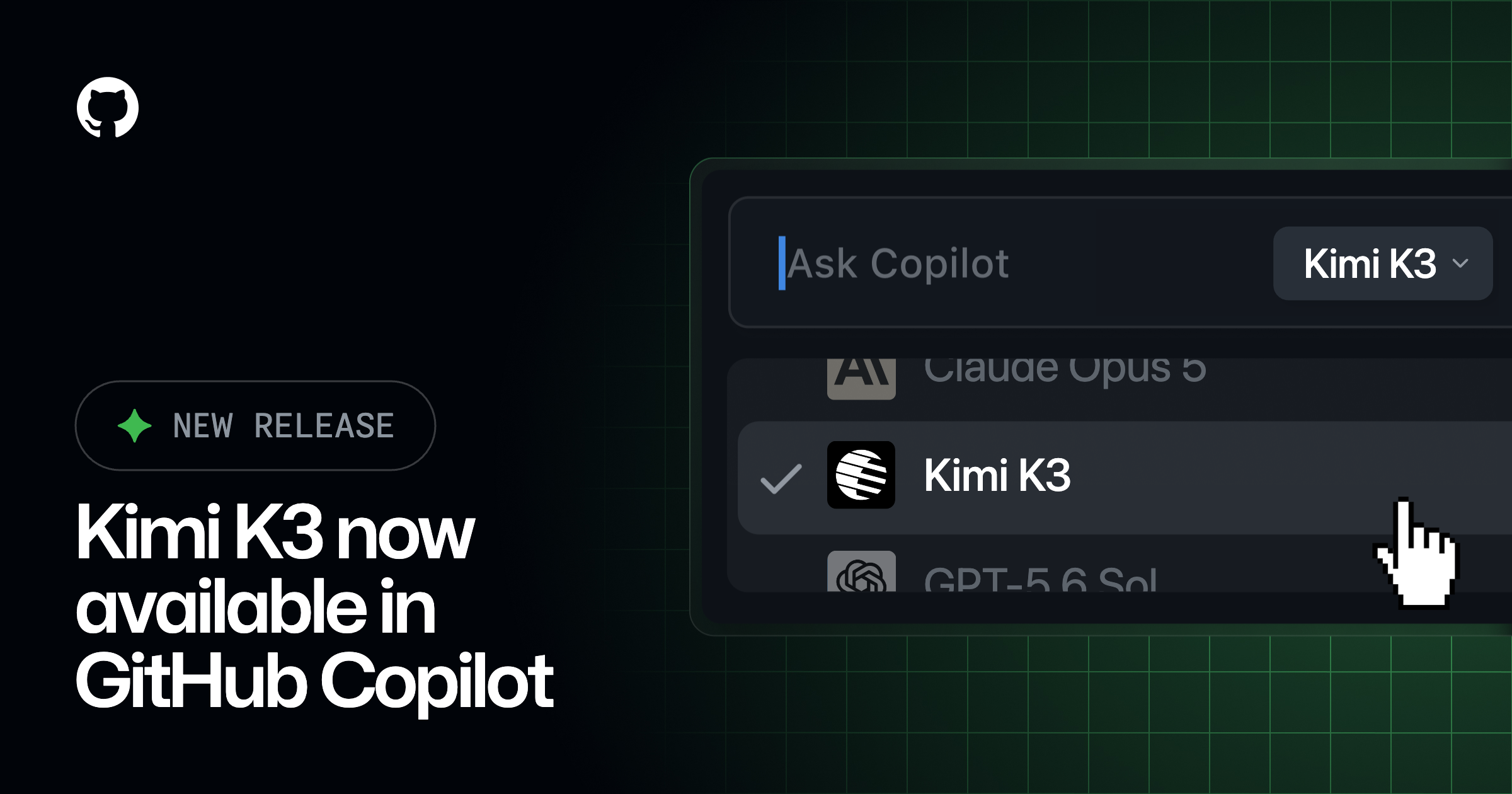
  3. 05Kimi K3 is now available in GitHub Copilot

    Kimi K3, an open-weight model, is now available in GitHub Copilot, offering advanced coding capabilities at competitive pricing. It is accessible across various platforms including Visual Studio Code and Jetbrains, but requires activation for Copilot Business and Enterprise users.

  4. 06Right Reset: Chunking by Prefix Removal

    The Right Reset (RR) method enhances prefix-removal probing in causal language models, achieving a 47.7% recovery rate of original records compared to 25.9% with BGE embeddings. This technique minimizes local output disruption across six models and shows that context dependence can signal boundaries effectively.

  5. 07DataRx: Missingness-Aware Sampling for Safer Large Language Model Task-Specific Fine-Tuning

    DataRx introduces a missingness-aware sampling method that enhances safety in large language model fine-tuning. By selecting safety-critical examples based on high-dimensional hidden representations, it reduces the attack success rate of Llama3-8B-Instruct from 59.23% to 13.70% with just 1% additional safety samples. This method aims to inspire further research into data-centric defenses.

  6. 08When More Becomes Less: Position-Dependent Repetition Effects in Language Models

    This study reveals that the effect of repeated tokens in language models is position-dependent, with adjacent repetitions showing a plateau in prediction probability, while displaced repetitions exhibit an inverted-U effect. The findings are consistent across 13 models, including multilingual tests in Spanish, Chinese, German, and French, indicating that readout position significantly influences prediction outcomes.

  7. 09Tesla and SpaceX will invest $16.8B to start building ‘Terafab’ chip factory in Texas

    Tesla and SpaceX will invest $16.8 billion to build the 'Terafab' chip factory in Texas, aiming to create over 100 million square feet of manufacturing space and employ at least 3,000 people. This facility will produce advanced chips to meet the growing demand for computing power in future technologies, including AI and robotics.

  8. 10Introducing Kitesurf: The agent-first browser that runs in V8 isolates on Cloudflare Workers

    Cloudflare introduces Kitesurf, a new agent-first browser running on Workers, optimized for AI tasks with significantly lower CPU and memory usage compared to Chromium, enabling broader access for AI agents.

  9. Papers

    Recent research in AI and language models highlights significant developments and challenges. The introduction of GEB-Bench, a benchmark for evaluating models on abstract structural motifs, reveals a gap in cross-voice mapping, indicating that while models excel in single-voice recognition, they struggle with different representations (GEB-Bench). Additionally, a study on a foraging agent utilizing active inference demonstrates that dynamic allocation of interoceptive precision can double survival rates during learning phases, showcasing the importance of selective attention in AI (Interoceptive Attention). Furthermore, the Right Reset method improves prefix-removal probing in causal language models, achieving a notable recovery rate of original records (Right Reset). These findings underscore the need for ongoing refinement in model capabilities and resource allocation strategies, which are critical for builders and investors in the AI landscape.

    AI

    Recent advancements in AI technologies are reshaping various sectors. PDI Technologies has introduced PDI Brew, an agentic app deployer leveraging Amazon Bedrock, allowing non-technical employees to create web applications on AWS, thus streamlining internal tool delivery and removing deployment bottlenecks PDI Technologies. Meanwhile, Google DeepMind's WeatherNext AI model has made significant strides in cyclone forecasting, offering an additional day of predictive lead time, which is crucial for disaster preparedness Google DeepMind. Additionally, Cloudflare's Kitesurf browser optimizes AI tasks with reduced resource consumption, enabling broader access for AI agents Cloudflare. Lastly, Omilia's recent $67 million funding round emphasizes the growing demand for self-learning agents in customer support, focusing on strong unit economics Omilia. This convergence of innovations highlights the potential for builders and investors to capitalize on AI's transformative capabilities across diverse applications.

    WeatherNext: AI model achieves breakthrough in forecasting cyclones
    Google DeepMind
    Google DeepMind
    8/6/2026
    FeaturedOriginal

    WeatherNext: AI model achieves breakthrough in forecasting cyclones

    AI Summary

    Google DeepMind's WeatherNext AI model enhances cyclone forecasting accuracy, providing an extra day of predictive lead time. Open-sourced, it integrates global weather dynamics and historical cyclone data, achieving state-of-the-art results with a 24-hour advantage over previous models. This breakthrough aids forecasters and disaster preparedness, impacting communities globally.

    Why Featured

    Google DeepMind's WeatherNext AI model enhances cyclone forecasting accuracy by providing an extra day of predictive lead time. This development is significant for builders and PMs in disaster-prone areas as it allows for better planning and resource allocation, while investors can recognize opportunities in climate resilience technologies and services.

    #Inference#Open Source#AI Startup
    2
    arXiv cs.CV
    arXiv cs.CV·Tong Zhang, Zhiyuan Shi, Yun Peng, Tao Xie
    8/6/2026
    Original

    GEB-Bench: Abstract Structures Told in Many Voices

    AI Summary

    GEB-Bench introduces a benchmark for evaluating models on abstract structural motifs, revealing a significant gap in cross-voice mapping. Twelve models were tested, showing that while they excel in recognizing structures within a single voice, they struggle to transfer this understanding across different representations, with errors aligning more with formal geometries than perceptual ones.

    Why Featured

    The introduction of GEB-Bench highlights a critical gap in AI models' ability to generalize across different representations of abstract structures. For builders and PMs, this signals the need to focus on enhancing cross-voice mapping capabilities, while investors should consider the implications for model robustness in diverse applications.

    #LLM#AI Coding#Inference
    0
    arXiv cs.AI
    arXiv cs.AI·St John Grimbly, Nicolas Kuske, Evert A. Boonstra, Bruce A. Bassett, Charel van Hoof, Rowan Hodson, Benjamin Rosman, Ryan Smith, Mark Solms, Jonathan P. Shock
    8/6/2026
    FeaturedOriginal

    Interoceptive Attention as Dynamic Homeostatic Prioritization in a Foraging Agent

    AI Summary

    The study presents a foraging agent utilizing active inference to dynamically allocate interoceptive precision, resulting in over double the survival rate during learning phases compared to uniform-precision agents (0.414 vs 0.199). This selective attention enhances both planning and perception, with significant implications for artificial intelligence in resource allocation.

    Why Featured

    The development of a foraging agent that uses interoceptive attention to prioritize resource allocation demonstrates a significant improvement in survival rates during learning phases. This insight can inform builders and PMs about enhancing AI models for dynamic decision-making and resource management, while investors may see potential for applications in robotics and adaptive systems.

    #Agent#Inference#AI Startup
    2
    Kimi K3 is now available in GitHub Copilot
    GitHub Copilot Changelog
    GitHub Copilot Changelog·Walker Chabbott
    8/6/2026
    FeaturedOriginal

    Kimi K3 is now available in GitHub Copilot

    AI Summary

    Kimi K3, an , is now available in GitHub Copilot, offering advanced coding capabilities at competitive pricing. It is accessible across various platforms including Visual Studio Code and Jetbrains, but requires activation for Copilot Business and Enterprise users.

    Why Featured

    The integration of Kimi K3 into GitHub Copilot enhances coding capabilities for developers, allowing for more efficient and cost-effective software development. Builders and PMs should consider this as a significant tool for improving productivity, while investors may see potential in the competitive edge it provides to teams utilizing advanced AI coding assistance.

    #AI Coding#Open Source#AI Assistant#Enterprise AI
    0
    arXiv cs.CL
    arXiv cs.CL·Mike Vegeto
    8/6/2026
    FeaturedOriginal

    Right Reset: Chunking by Prefix Removal

    AI Summary

    The Right Reset (RR) method enhances prefix-removal probing in causal language models, achieving a 47.7% recovery rate of original records compared to 25.9% with BGE embeddings. This technique minimizes local output disruption across six models and shows that context dependence can signal boundaries effectively.

    Why Featured

    The Right Reset (RR) method significantly improves prefix-removal probing in causal language models, achieving a 47.7% recovery rate of original records. This development indicates a more effective way to manage context dependence, which can enhance the performance of AI applications in natural language processing, making it crucial for builders and PMs focusing on model accuracy and efficiency.

    #LLM#Inference#Open Source
    0
    Right Reset: Chunking by Prefix Removal
    — arXiv cs.CL
  10. 07DataRx: Missingness-Aware Sampling for Safer Large Language Model Task-Specific Fine-Tuning— arXiv cs.CL
  11. 08When More Becomes Less: Position-Dependent Repetition Effects in Language Models— arXiv cs.CL
  12. 09Tesla and SpaceX will invest $16.8B to start building ‘Terafab’ chip factory in Texas— TechCrunch
  13. 10Introducing Kitesurf: The agent-first browser that runs in V8 isolates on Cloudflare Workers— Cloudflare AI
  14. 11Diagnosing Tool-Selection Reasoning in LLM Agents with Canary Tools— arXiv cs.AI
  15. 12What Is a Skill Worth? Structure-Aware Shapley Valuation of Agent Skills— arXiv cs.AI
  16. 13Architectural Implications of Agentic AI Workflows— arXiv cs.AI
  17. 14NeuMoSync: End-to-End Neuromodulatory Control for Plasticity and Adaptability in Continual Learning— arXiv cs.AI
  18. 15FinReportBench: Measuring and Improving Institution-Grade Financial Report Generation— arXiv cs.CL
  19. 16Configure rate limits for AI traffic on AgentCore gateway— AWS Machine Learning
  20. 17Control agent behaviors and cost beyond a single action: new capabilities in Amazon Bedrock AgentCore— AWS Machine Learning
  21. 18Omilia raises $67M to scale its customer support platform— TechCrunch
  22. 19Exclusive: Mirendil inks $100M+ Google Cloud deal to scale self-improving AI— TechCrunch
  23. 20Naïve raises $28.5M to automate the grunt work of setting up and running a company— TechCrunch