https://github.blog/changelog/label/copilot/
GitHub Copilot now enhances usage metrics by incorporating server-side telemetry, revealing previously unreported active users. This update increases daily active user counts and improves report consistency, addressing gaps caused by client-side telemetry failures.
GitHub Copilot's integration of server-side telemetry to enhance usage metrics is significant as it provides a more accurate count of daily active users, which can inform product development and marketing strategies. For builders and PMs, this means better insights into user engagement, while investors can assess the platform's growth potential more reliably.
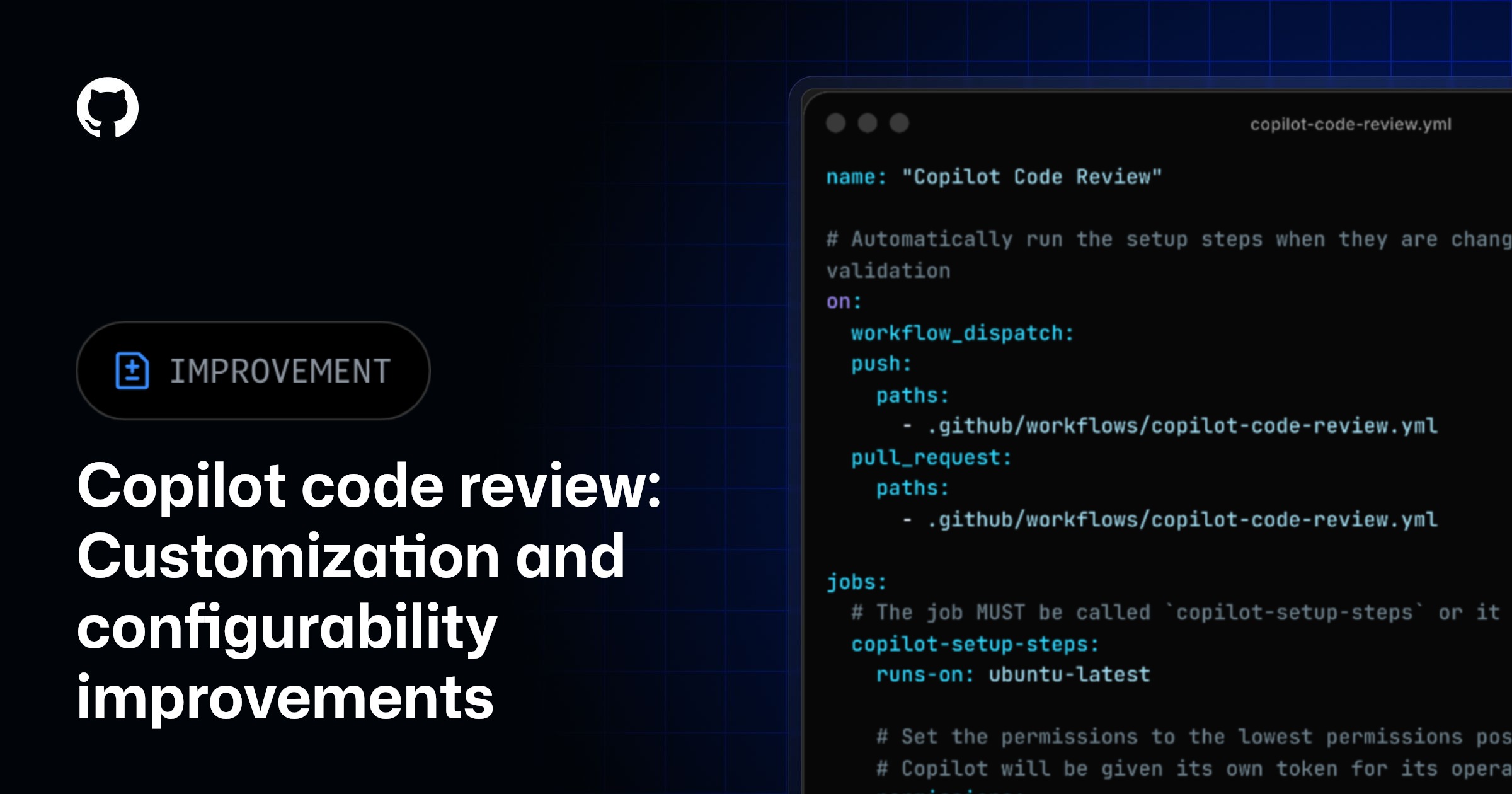
GitHub Copilot code review now features organization-level runner controls, content exclusion support, and removed character limits on custom instructions, enhancing customization for repository management. Admins can set default runners across all repositories and exclude specific files during reviews.
The introduction of organization-level runner controls and content exclusion support in GitHub Copilot code review allows builders and PMs to streamline their code review processes by customizing settings across repositories, ultimately improving team efficiency. For investors, this enhancement indicates GitHub's commitment to providing robust tools that can attract more enterprise users, potentially driving revenue growth.
GitHub Copilot CLI introduces a unified /settings command for streamlined configuration, integrating previously scattered commands into a single interface. Users can now easily adjust settings through a guided UI, inline commands, or scripted changes, enhancing usability and reducing errors in configuration.
The introduction of the unified /settings command in GitHub Copilot CLI simplifies the configuration process, making it more user-friendly and less error-prone. This development is significant for builders and PMs as it streamlines workflows and enhances productivity, while investors should note its potential to attract more users seeking efficient development tools.
GitHub Agentic Workflows is now in public preview, enabling automation of reasoning-based tasks like issue triage and CI failure analysis using natural language Markdown. This feature allows teams to save hours on repetitive tasks, enhancing productivity and security with built-in safeguards.
GitHub's public preview of Agentic Workflows allows teams to automate reasoning-based tasks like issue triage and CI failure analysis using natural language Markdown. This development can significantly enhance productivity by reducing time spent on repetitive tasks, making it a valuable tool for builders and PMs focused on efficiency and resource optimization.
GitHub Agentic Workflows now utilize the built-in GITHUB_TOKEN, removing the need for personal access tokens (PATs) and enhancing security. This change allows organizations to directly bill AI credits consumed by workflows, streamlining cost management without user-level inference budgets. Users must enable specific Copilot policies and ensure they are on the latest Agentic Workflows CLI version.
The shift to using GITHUB_TOKEN in GitHub Agentic Workflows eliminates the need for personal access tokens, enhancing security and simplifying cost management for organizations. This allows builders and PMs to focus on development without worrying about user-level access issues, while investors can see a clearer path to efficient resource allocation and reduced operational risks.
GitHub Copilot Chat now integrates with Copilot cloud agent, allowing users to track agent session statuses and query past sessions. New features include agent logs retrieval and session search for improved workflow continuity.
The integration of GitHub Copilot Chat with Copilot cloud agent allows builders and PMs to track and query agent sessions, enhancing workflow continuity and productivity. For investors, this development signals a commitment to improving user experience and operational efficiency, potentially increasing adoption and retention rates in AI-driven development tools.
GitHub Copilot CLI now includes an experimental /security-review command that allows developers to analyze local code changes for security vulnerabilities. This feature provides actionable insights on high-impact issues across 11 categories, enhancing the security of code before it reaches production.
The introduction of the /security-review command in GitHub Copilot CLI allows developers to proactively identify security vulnerabilities in their code before deployment, which is crucial for maintaining software integrity and reducing potential risks. This feature not only enhances code security but also streamlines the development process, making it a valuable tool for builders, PMs, and investors focused on risk management and efficiency.
Claude Fable 5 is now available in GitHub Copilot, designed for autonomous coding tasks, outperforming previous models with fewer tool calls and lower token usage. It requires data retention for safety classifiers, affecting Copilot Pro+, Max, Business, and Enterprise users, while other Claude models remain under Zero Data Retention.
The general availability of Claude Fable 5 in GitHub Copilot enhances autonomous coding capabilities, allowing developers to produce code more efficiently with reduced resource consumption. For builders and PMs, this means improved productivity and cost-effectiveness, while investors should note the competitive edge it provides in the AI-assisted development landscape.
GitHub has launched automatic security validation for third-party coding agents like Claude and OpenAI Codex, ensuring that all generated code is analyzed for vulnerabilities using CodeQL and other tools. This feature, available by default, extends the same protections already in place for GitHub Copilot, enhancing security across repositories without requiring an Advanced Security license.
GitHub's launch of automatic security validation for third-party coding agents like Claude and OpenAI Codex means that builders and PMs can now rely on enhanced security measures for their code without additional costs. This development signals a shift towards safer coding practices, potentially reducing vulnerabilities in software products and increasing investor confidence in the security of AI-generated code.
As of June 5, 2026, GitHub has deprecated GPT-5.2 and GPT-5.2-Codex models across most Copilot experiences, recommending users transition to GPT-5.5 and GPT-5.3-Codex respectively. Administrators should enable access to these alternatives in Copilot settings, while GPT-5.2 remains available for code review.
The deprecation of GPT-5.2 and GPT-5.2-Codex by GitHub signals a shift towards more advanced AI models, specifically GPT-5.5 and GPT-5.3-Codex, which are likely to offer improved performance and capabilities. Builders and PMs should prioritize transitioning to these models to leverage enhanced features, while investors should note the ongoing evolution in AI tools that could impact development timelines and costs.