https://weaviate.io/blog

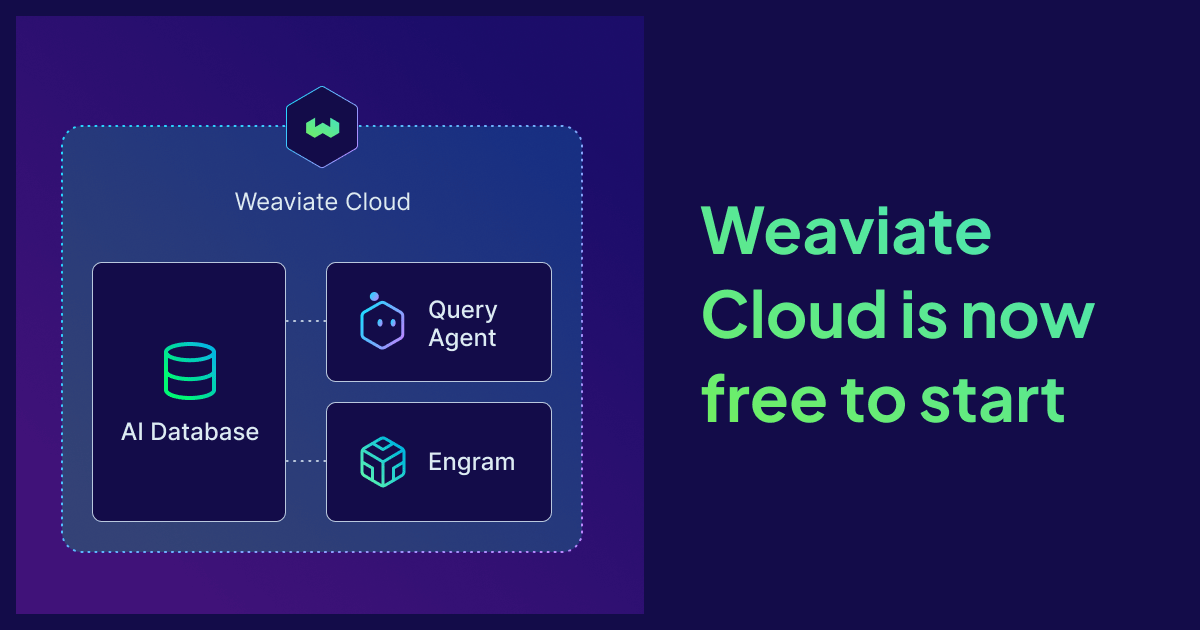
Weaviate Cloud has launched a free tier across its entire product suite, allowing users to start utilizing its vector search capabilities without any initial costs. This move aims to democratize access to advanced AI tools for developers and businesses looking to implement machine learning solutions.
Weaviate Cloud's introduction of a free tier for its vector search capabilities lowers the barrier to entry for developers and PMs, enabling them to experiment with advanced AI tools without upfront costs. This democratization of access can accelerate innovation in machine learning solutions, making it an attractive opportunity for investors looking to support emerging technologies.
Weaviate's Model Context Protocol (MCP) simplifies building coding assistants by integrating retrieval-augmented generation (RAG) over code and documentation, enhancing LLMs like Claude Code with hybrid search capabilities. This setup allows efficient querying of codebases while minimizing token costs and stale context issues.
Weaviate's Model Context Protocol (MCP) enables builders and PMs to create more efficient coding assistants by leveraging retrieval-augmented generation (RAG) for real-time code querying. This development reduces token costs and stale context issues, making it a cost-effective solution for enhancing developer productivity and improving user experience in coding environments.
Research indicates that poor retrieval quality is the primary cause of hallucinations in LLMs, significantly affecting output reliability. The study highlights five failure modes in retrieval processes, emphasizing that scaling models won't resolve these issues. Effective retrieval is crucial for accurate, contextually grounded language generation.
The research highlights that poor retrieval quality is a major cause of hallucinations in LLMs, indicating that simply scaling models won't enhance reliability. Builders and PMs should prioritize improving retrieval systems to ensure accurate and contextually relevant outputs, while investors should consider the implications for product viability and market competitiveness.
Weaviate v1.37 introduces significant enhancements including a built-in Server for seamless LLM integration, extensible tokenizers for improved text analysis, and Diversity Search for reduced redundancy in vector results. Additional features like Incremental Backups and a new BlobHash property type further enhance large-scale operations.
The Weaviate v1.37 release introduces a built-in MCP Server for LLM integration, which streamlines the process of deploying AI models, making it easier for builders to implement advanced features. Additionally, the Diversity Search feature enhances result relevance, which is crucial for PMs seeking to improve user experience and for investors focusing on scalable AI solutions.
Weaviate Shared Cloud is now available on AWS, allowing teams to leverage a fully managed AI-native platform in the US East and Europe. Key features include automatic upgrades, granular RBAC, and tools for faster AI application development, such as the Query Agent and Data Import Tool.
The general availability of Weaviate Shared Cloud on AWS provides builders and PMs with a fully managed AI-native platform, simplifying the development process with features like automatic upgrades and tools for faster application development. For investors, this signals a growing market for scalable AI solutions, enhancing the potential for returns in AI-driven projects.
Engram, Weaviate's new memory product, enhances Claude Code's workflow by providing contextual memory that improves decision-making speed by 30%, addressing the limitations of the default MEMORY.md system. Early tests show that Engram allows for more fluid interactions, reducing the need for repetitive context re-establishment.
The launch of Engram, Weaviate's new memory product, enhances Claude Code's workflow by improving decision-making speed by 30%. This development signifies a shift towards more efficient AI interactions, allowing builders and PMs to create applications that require less user context re-establishment, ultimately leading to better user experiences and increased productivity.
Multimodal embeddings enable the integration of text, images, audio, and video into a unified embedding space, enhancing retrieval systems by allowing queries across different data types. Models like CLIP and ImageBind demonstrate the effectiveness of contrastive learning for aligning modalities, paving the way for practical applications in knowledge bases that include diverse formats.
The development of multimodal embeddings, as demonstrated by models like CLIP and ImageBind, allows for more effective retrieval systems that can process and query diverse data types simultaneously. This capability is crucial for builders and PMs looking to enhance user experience in applications like search engines and knowledge bases, while investors should note the potential for increased efficiency and innovation in data-driven solutions.
Weaviate provides a comprehensive guide for securing enterprise deployments using OIDC for authentication, RBAC for access control, and multi-tenant isolation to enhance data security. These measures are crucial for organizations looking to protect sensitive information while leveraging AI capabilities effectively.
Weaviate's guide on securing enterprise AI through OIDC, RBAC, and multi-tenant isolation is significant for builders and PMs as it addresses critical security concerns in AI deployments. Investors should note that robust security measures can enhance trust and adoption of AI solutions in enterprises, potentially leading to increased market opportunities and growth.
Weaviate introduces Agent Skills, a repository designed to enhance coding agents' capabilities by bridging them with Weaviate's infrastructure, enabling efficient schema management, data lifecycle operations, and advanced retrieval methods. This tool supports popular coding environments like Claude Code and GitHub Copilot, streamlining the development process for applications using Weaviate.
The introduction of Weaviate Agent Skills enhances coding agents' capabilities by integrating them with Weaviate's infrastructure, which streamlines schema management and data operations. This development is significant for builders and PMs as it can accelerate application development, while investors should note its potential to improve productivity in AI-driven coding environments, increasing market competitiveness.
Weaviate highlights the critical need for memory and continuity in AI applications to prevent inefficiencies and confusion, especially as agents operate at machine scale. The absence of continuity leads to repetitive tasks and outdated information, exacerbating the limitations of current LLMs in production environments.
Weaviate's emphasis on the necessity of memory and continuity in AI applications highlights a critical gap in current LLMs, which can lead to inefficiencies in production. Builders and PMs should prioritize integrating memory features in their AI systems to enhance performance and user experience, while investors should consider supporting solutions that address these limitations.