Daily Brief
Today's AI brief, summarized in minutes.
DeepSignal — 2026-07-11
Today's 9 highest-signal stories across 3 verticals, curated by DeepSignal.
Finalised. Subscribers will receive this shortly.
9 stories3 verticals
Today's Highlights
9 highlights- 01[AINews] not much happened today
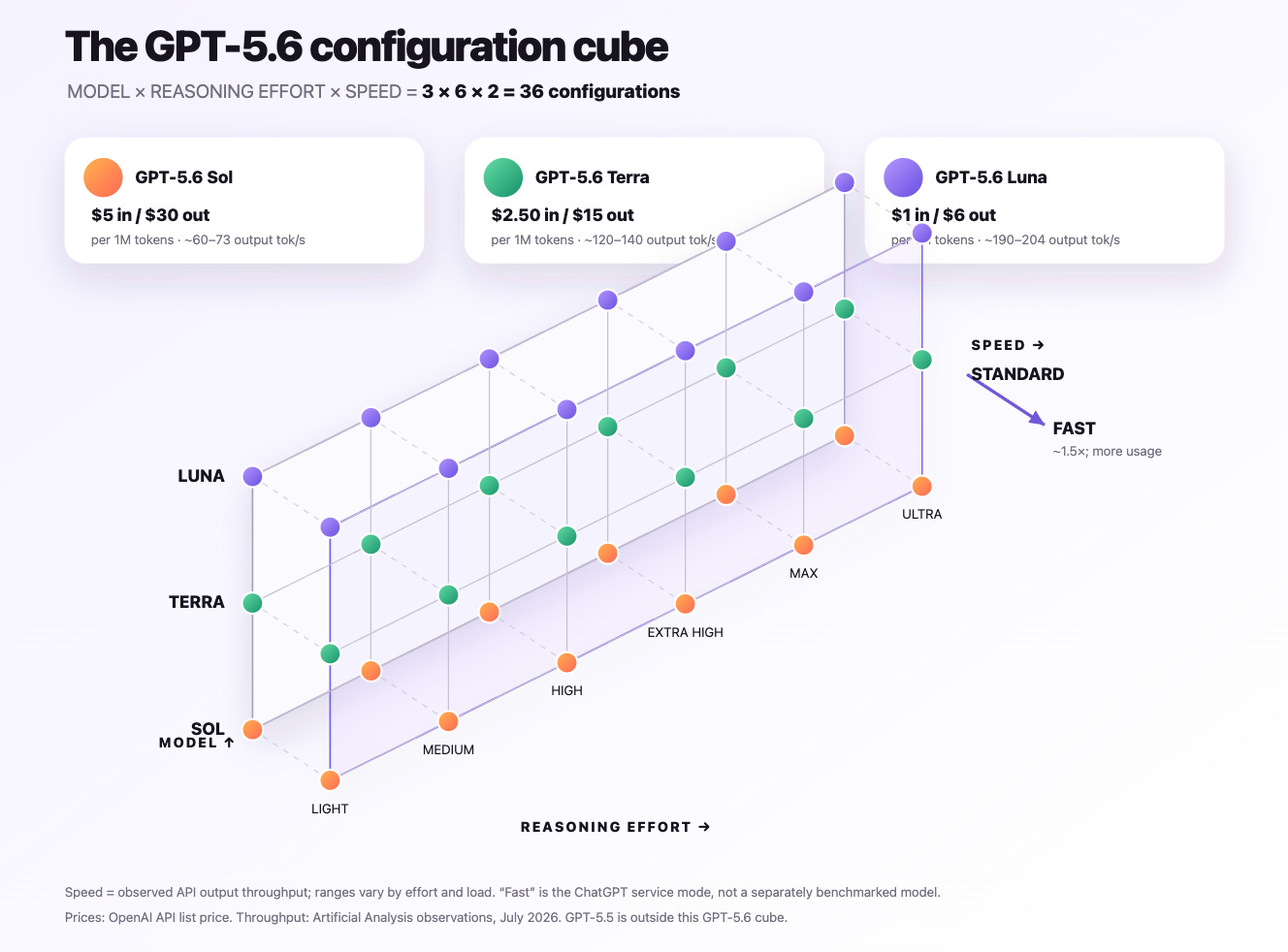 OpenAI's GPT-5.6 rollout introduces a complex model stratification with Luna, Terra, and Sol variants, causing confusion among users regarding performance and costs. Initial benchmarks show GPT-5.6 excels in agentic coding and presentation tasks but has raised concerns over instruction-following and cost transparency, especially with hidden subagent costs. The launch faced UX regressions, prompting OpenAI to quickly address user feedback and reset usage limits.
 - 02OpenAI admits it "didn't get everything quite right" with ChatGPT Work launch and scrambles to fix UX and costs
Today by Vertical
3 verticalsSecurity
Recent developments in the tech security landscape highlight significant concerns regarding the misuse of AI and the protection of trade secrets. Apple has filed a lawsuit against OpenAI, alleging that it orchestrated a campaign to steal trade secrets by poaching employees, including its Chief Hardware Officer, Tang Tan, and encouraging them to share confidential information, as reported in The Decoder. Meanwhile, Meta's decision to remove a controversial AI feature from Instagram, which allowed users to modify public photos without consent, underscores the growing backlash against AI technologies that may infringe on user rights, as noted by TechCrunch. Additionally, a study reveals that terrorist organizations are exploiting AI chatbots for attack planning and weapons development, raising alarms about the potential for AI-assisted threats, as detailed in The Decoder. What this means for builders/investors is the urgent need to prioritize ethical considerations and security measures in AI development and deployment.
Policy
OpenAI is currently addressing significant user feedback issues following the launch of ChatGPT Work and GPT-5.6 Sol, as detailed in their acknowledgment of problems such as high compute settings and data deletion incidents, which they aim to rectify by resetting usage limits and enhancing user guidance. This comes alongside a strategic shift to focus on family-oriented experiences, driven by a notable increase in users aged 35 and older, now comprising 31% of the user base in Q2 2023. The company is responding to rising concerns regarding AI's impact on children by prioritizing safety measures tailored for younger users. This dual approach of improving user experience while expanding demographic reach indicates a proactive stance by OpenAI, which is crucial for builders and investors navigating the evolving landscape of AI technology. OpenAI admits it "didn't get everything quite right" with ChatGPT Work launch and scrambles to fix UX and costs OpenAI bets on families as ChatGPT goes deeper into households
Today's Observations
7 observations- OpenAI's GPT-5.6 rollout reveals confusion in model stratification. Builders must clarify performance metrics to avoid user dissatisfaction.
- Apple's lawsuit against OpenAI highlights trade secret vulnerabilities. Operators should reassess employee data security practices.
- Meta's removal of AI features due to backlash emphasizes user trust. Investors should prioritize ethical AI development to avoid public relations issues.
- AI chatbots are being exploited by terrorist groups for planning. Security firms must enhance monitoring and countermeasures against AI misuse.
- OpenAI's focus on family-oriented ChatGPT experiences indicates a market shift. Investors should consider family safety features as a competitive advantage.
- China's Orca model achieves state-of-the-art results without labeled data. Robotics developers should explore unsupervised learning for efficiency gains.
- OpenAI's acquisition of Northslope enhances enterprise AI deployment. Investors should watch for increased integration capabilities in business operations.
Featured
6 stories7/11/2026
FeaturedOriginal
[AINews] not much happened today
AI Summary
OpenAI's GPT-5.6 rollout introduces a complex model stratification with Luna, Terra, and Sol variants, causing confusion among users regarding performance and costs. Initial benchmarks show GPT-5.6 excels in agentic coding and presentation tasks but has raised concerns over instruction-following and cost transparency, especially with hidden subagent costs. The launch faced UX regressions, prompting OpenAI to quickly address user feedback and reset usage limits.
Why Featured
The rollout of OpenAI's GPT-5.6 introduces a complex model stratification that can impact cost management and user experience for builders and PMs. Understanding the performance differences among the Luna, Terra, and Sol variants is crucial for making informed decisions on deployment and budgeting, particularly given the initial concerns over instruction-following and hidden costs.
References
9 articles- 01[AINews] not much happened today— Latent Space
- 02OpenAI admits it "didn't get everything quite right" with ChatGPT Work launch and scrambles to fix UX and costs— The Decoder
- 03Apple sues OpenAI for allegedly running a "coordinated campaign" to steal trade secrets through poached employees— The Decoder
- 04Meta removes controversial AI feature on Instagram after backlash— TechCrunch
- 05OpenAI's GPT-5.6 Sol Ultra reportedly solves a 50-year-old math problem in under an hour— The Decoder
- 06


